Climate-Smart Agriculture Practices for Different Crops in Pakistan
Discover climate-smart agriculture practices for different crops in Pakistan, including water-efficient and climate-resilient farming techniques.

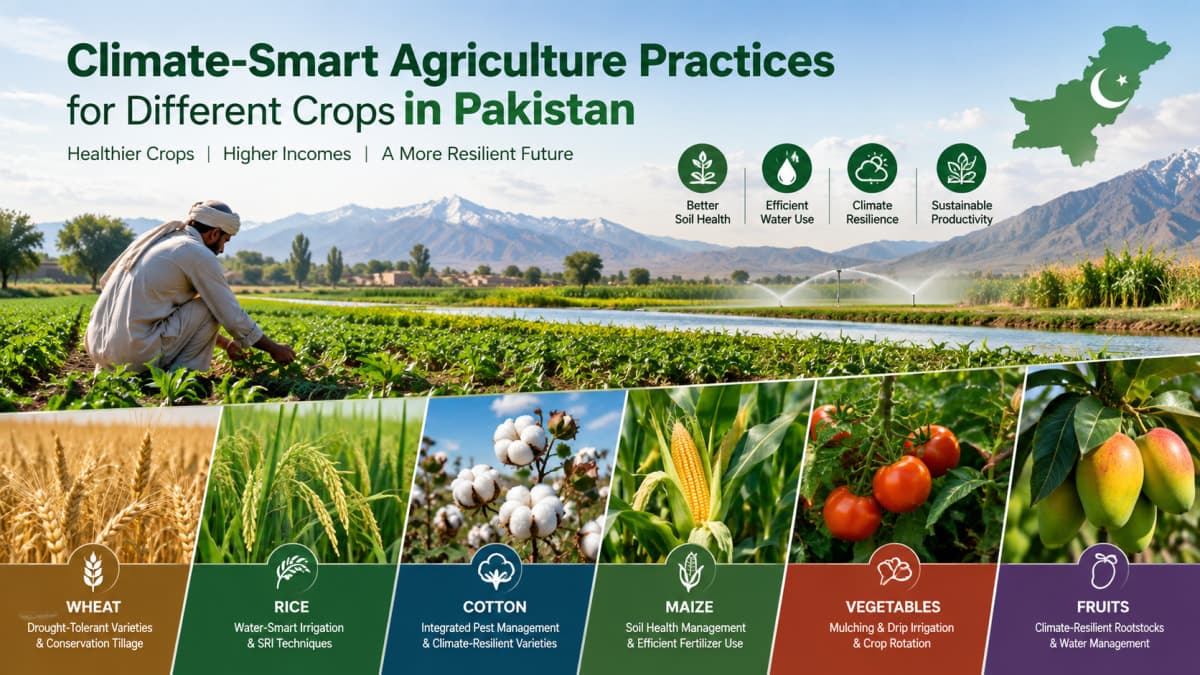
Introduction
Agriculture is one of the most important sectors of Pakistan's economy. It contributes about 23% in national GDP and provides 40% employment share. So, it plays a vital role in food security, rural livelihoods, economy and national development. However, the sector is increasingly affected by climate change. Rising temperatures, erratic rainfall patterns, long duration droughts, floods, heat waves, and shifting pest and disease patterns are creating significant challenges for crop production. These challenges highlight the need for farming approaches that can maintain productivity while using natural resources more efficiently.
Climate-smart agriculture (CSA) provides an approach to address these challenges by promoting agricultural practices that aim to achieve three interconnected objectives: sustainably increasing agricultural productivity, strengthening resilience and adaptation to climate change, and reducing or avoiding greenhouse gas (GHG) emissions where possible. Climate-smart practices can help farmers use water, soil, fertilizers, energy, and other inputs more efficiently while reducing their vulnerability to climate-related stresses.
In Pakistan, the relevance of climate-smart agriculture varies among crops because each crop has different water requirements, growing seasons, production systems, and climate sensitivities. Practices such as zero tillage, drought and heat-tolerant varieties, balanced fertilizer application, drip irrigation, raised-bed planting, direct seeding, alternate wetting and drying (AWD), crop rotation, intercropping, precision plant spacing, dual-row planting, integrated pest management, and ratoon management can contribute to more resilient and resource-efficient crop production.
This blog discusses important climate-smart agriculture practices for major crops in Pakistan, including wheat, cotton, rice, maize, and sugarcane. It explains how these practices can improve resource-use efficiency, strengthen crop resilience to climate stresses, and contribute to reducing the environmental footprint of agricultural production.
1. Climate Smart Practices in Wheat Crop
a. Zero tillage
Zero tillage practice protects the soil structure, organic matter and moisture content which lead to efficient resource utilization and environmental sustainability. Moreover, it eliminates or greatly reduces tractor operations for ploughing, harrowing, and seedbed preparation. This lowers diesel consumption and consequently reduces carbon dioxide (CO₂) emissions.
b. Use of heat/drought tolerant varieties
The impact of this climate smart practice is not just limited to enhancing water use efficiency. It also increases resilience to moisture stress and climate shocks. Moreover, it provides moderate reduction in GHG emissions per unit of food produced.
c. Seasonal adopted planting time
Adjusting the cropping calendar by planting with the onset of rains reduces losses due to changing weather patterns which also provides reduction in GHG emissions.
d. Balanced use of fertilizer
Balanced organic fertilization reduces GHG carbon foot print and emission associated to synthetic fertilizer use. In addition, it reduces runoff and risk of nutrient leaching into groundwater.
2. Climate Smart Practices in Cotton Crop
a. Use of heat/drought tolerant varieties
Use of heat tolerant varieties provides resilience against climate shocks like heat waves and droughts, increase water use efficiency and reduce GHG emissions.
b. Drip irrigation
Use of drip irrigation reduces soil erosion, improve nutrient and water use efficiency in drought prone areas. In addition, use of high efficiency irrigation systems (HEIS) like drip is energy efficient and reduce GHG emission at source.
c. Sowing in ridges and raised beds
This practice lowers the risk of rot due to heavy rainfall along with improving the water use efficiency. It also reduces emissions from the use of synthetic fertilizer.
d. Integration of organic fertilizer
Enhance soil quality, water retention and increase the system resilience against climate shocks. With this approach, use of nitrogen fertilizer reduces which ultimately lower the GHG emissions.
3. Climate Smart Practices in Rice Crop
a. Direct seeding
It promotes efficient use of water. The practice may contribute to reductions in GHG emissions by reduced use of fossil fuels.
b. Alternate wetting and drying (AWD)
In AWD methos, water is not kept in standing position, Instead, water is applied intermittently which ultimately enhance water use efficiency. AWD approach allows crop production under water scarce conditions. It reduces methane emissions from permanent flooding.
c. Correct timing of harvesting
Harvesting of crop at right time reduces the risk to extreme climate conditions, without compromising production and quality of produce. It provides moderate reduction in GHG emissions per unit of food produced.
d. Synchronization of transplantation and fertilization timing
It reduces water demand and thus reducing pressure on natural resources and also increase resilience to drought. Increases production efficiency and potentially reduce GHG emissions.
4. Climate Smart Practices in Maize Crop
a. Use of early maturing varieties
This practice optimizes the use of available soil moisture contributing to avoid crop loss. In addition, increase water use efficiency and reduce GHG emissions.
b. Inter cropping and crop rotation
Crop rotation protects the soil structure, nutrients and organic carbon reserves. Leguminous species integration reduces the need of nitrogen-based synthetic fertilizer. Moreover, growing maize with other crops such as legumes improve resource use, diversify farm production and soil fertility.
c. Use of heat resistant and pest tolerant varieties
Such varieties reduce the risk of crop damage due to pest and climate hazards. This practice limits the use of synthetic pesticides and fungicides, thus reducing the GHG emissions and carbon footprints.
d. Proper plant population and row spacing
Maintaining proper plant population and row spacing ensures efficient utilization of sunlight, nutrients and water. Efficient resource utilization contributes to more stable yield under moisture and heat stresses.
5. Climate Smart Practices in Sugarcane Crop
a. Dual row planting
In dual row planting, two rows are planted closer together to form a paired row, with a wider space between paired sets. It improves sunlight and space utilization, facilitates mechanization, and can improve water use efficiency.
b. Crop rotation with soya bean
This practice minimizes the incidence of pests and diseases. When combined with nitrogen fixation species (leguminous) reduces the use of synthetic fertilizer and also improve soil fertility.
c. Drip irrigation/fertigation
Sowing sugarcane on drip system delivers water and nutrients directly to the root zone which not only reduces water losses but also improve nutrient-use efficiency and water-use efficiency. In addition, use of HEIS like drip is energy efficient and reduce GHG emission at source.
d. Integrated pest management
It reduces crop losses even during moisture stress conditions and represents an ecological alternative for pest control.
e. Ratoon management
The ratoon crop uses the existing root system and buds, so farmers do not need to prepare the field and plant new cane from scratch. Because the field does not have to be completely replanted, ratooning can also reduce energy use and greenhouse-gas emissions per unit of cane produced.
Conclusion
Climate change is creating growing challenges for crop production in Pakistan, making the adoption of climate-smart agriculture practices increasingly important. No single practice can address all climate-related risks. Instead, a combination of appropriate technologies like improved crop management and efficient use of inputs is needed to build resilient agricultural systems.
The practices discussed for wheat, cotton, rice, maize, and sugarcane demonstrate that climate-smart agriculture can be applied across different cropping systems. Zero tillage and drought-tolerant varieties can help wheat farmers conserve soil moisture and adapt to changing climatic conditions. In cotton, drip irrigation, raised-bed planting, and organic fertilizer integration can improve water and nutrient-use efficiency. Direct seeding and alternate wetting and drying (AWD) can help make rice production more water-efficient while reducing methane emissions. For maize, early-maturing varieties, crop rotation, intercropping, and appropriate plant population can improve resilience and resource utilization. In sugarcane, dual-row planting, drip irrigation and fertigation, crop rotation, integrated pest management, and ratoon management can contribute to more efficient and sustainable production.
The effectiveness of these practices, however, depends on local climate conditions, soil characteristics, water availability, farm size, access to technology, and farmer’s knowledge and resources. Therefore, climate-smart agriculture should be promoted through locally adapted recommendations, farmer training, improved access to climate-resilient technologies, efficient irrigation systems, quality seed, and appropriate extension services.
Ultimately, adopting climate-smart practices can help Pakistan's farmers produce more efficiently, adapt to increasing climate risks, conserve scarce natural resources, and reduce the environmental impacts of agriculture. Integrating these practices into crop production is an important.
REFERENCES
https://poverty.com.pk/index.php/Journal/article/view/860/1020
https://www.pakbs.org/pjbot/papers/1671182798.pdf
https://www.sciencedirect.com/topics/agricultural-and-biological-sciences/harrowing
https://www.sciencedirect.com/topics/earth-and-planetary-sciences/crop-calendars
https://www.jaffer.com/jaspl/irrigation/
https://iconicagri.com/ratoon-management-in-sugarcane/
FAQs
What are the key practices of climate-smart agriculture?
Climate-smart agriculture (CSA) is an integrated approach that aims to increase productivity, enhance resilience to climate change, and reduce greenhouse gas emissions.
What are the four types of agricultural practices?
The four primary types of agricultural practices, often referred to in foundational crop production, are soil preparation, sowing, irrigation, and harvesting.
What are the 7 practices of sustainable agriculture?
The seven key practices of sustainable agriculture are Integrated Pest Management (IPM), crop rotation and diversity, soil management, water management, agroforestry, organic farming, and the use of renewable energy sources.