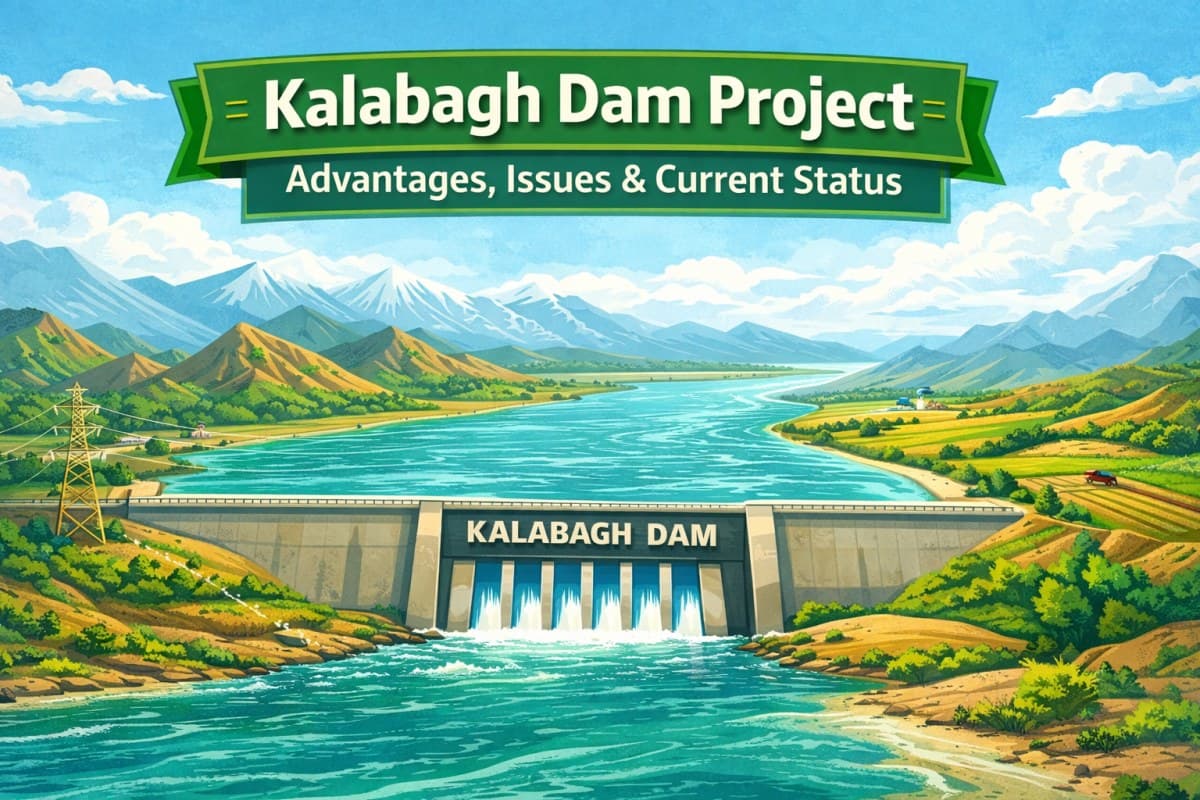
Kalabagh Dam Project: Advantages, Issues & Current Status
Explore the Kalabagh Dam project, its benefits, controversies, environmental concerns, and why it remains unbuilt so far.

1. Introduction
The Kalabagh Dam has been one of Pakistan’s most highly debated infrastructure projects for over four decades. Positioned on the Indus River in the Mianwali district, this proposed mega-dam promises significant socio-economic benefits but its future remains uncertain due to deep political divisions, environmental concerns, and technical debates. In this blog, we break down the advantages, issues, and current status of the Kalabagh Dam Project with referenced research insights.
“A dam is not just a wall of concrete; it is a promise to the future where water is respected, energy is renewed, and nature is used with wisdom, not waste."
2. What Is the Kalabagh Dam Project? Status and Technical Data
Kalabagh Dam project site is located 210 km downstream of Terbela Dam and 26 km upstream of Jinnah Barrage on the River Indus. Preliminary feasibility report of Kalabagh Dam Project was prepared by Tipton and Hill a firm of USA in the year 1956. Feasibility report of the project was drawn by M/s ACE Ltd; during 1975. Detailed designs and tender documents of this project were prepared during 1988 by Kalabagh Consultants a joint venure of Hazra of USA, Binnie & Partners of England, M/s NESPAK and ACE Ltd from Pakistan. Its primary goals were to:
- Store water for drought years
- Increase irrigation capacity
- Generate substantial hydropower
- Stabilize river flows and reduce flood risks
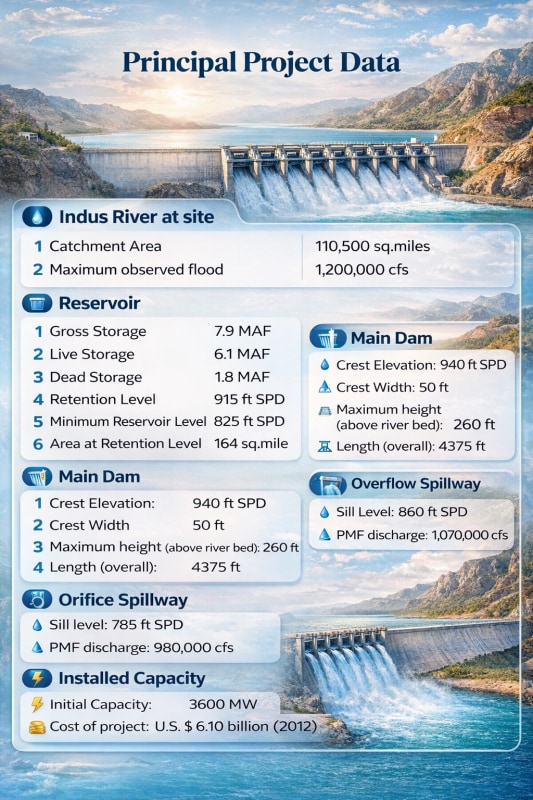
The project’s feasibility studies began with UNDP financing and World Bank involvement, but serious implementation was stalled by political disagreements and provincial mistrust. The principal project data of Kalabagh Dam is tabulated below:
3. Why Kalabagh dam project is important?
Pakistan receives 80% of its surface flow during 100 days whereas remaining 20% in 265 days. There is large variability in flows which leads to severe imbalance between supply and demand. Pakistan has 30-day storage which is very low as compare to the world average. Due to insufficient storage capacity, around 30 MAF flows directly goes to sea unutilized every year.(hydroinsight.online)
The annual 30 MAF of unused water that flows into the sea combined with only 30 days of storage capacity creates an escalating gap between water availability and national requirements. To minimize the difference between supply and demand, new storage dam need to build up.
4. Major Advantages of the Kalabagh Dam
Despite controversies, many experts and planners maintain that the dam could provide transformative benefits:
a. Water storage & irrigation security
Pakistan has three major storages including Terbela, Mangla and Chashma with overall live storage capacity of 18 MAF. Now the storage capacity has reduced to 14 MAF due to sedimentation. Pakistan hasn’t built any new storage dam since commissioning of Terbela in 1974. Due to increasing population, climate change and increasing cropping intensity, existing resources are under severe stress. Pakistan needs additional storage of 40 MAF by 2050 to cope up the said challenges.(hydroinsight.online). Moreover, Pakistan loses an estimated 30 million acre-feet (MAF) of water into the Arabian Sea each year due to insufficient storage. A dam like Kalabagh could significantly increase the country’s reservoir capacity and provide water security for agriculture, a major economic sector.
- Enhance irrigation for large tracts of farmland
- Support agricultural cycles during dry seasons
- Reduce dependency on monsoon patterns
b. Renewable hydropower generation
The dam is projected to produce up to 3,600 MW of electricity, contributing to Pakistan’s renewable energy targets and reducing dependency on costly thermal power. Potential benefits include:
- Lower electricity costs
- Decreased imports of fossil fuels
- Improved grid stability
c. Boost to economic Growth
Supporters argue that building the dam would:
- Create jobs in construction and operations
- Increase industrial output
- Reduce energy shortfalls restricting economic growth
- Save foreign exchange currently spent on power imports
5. Superiority of Kalabagh Dam
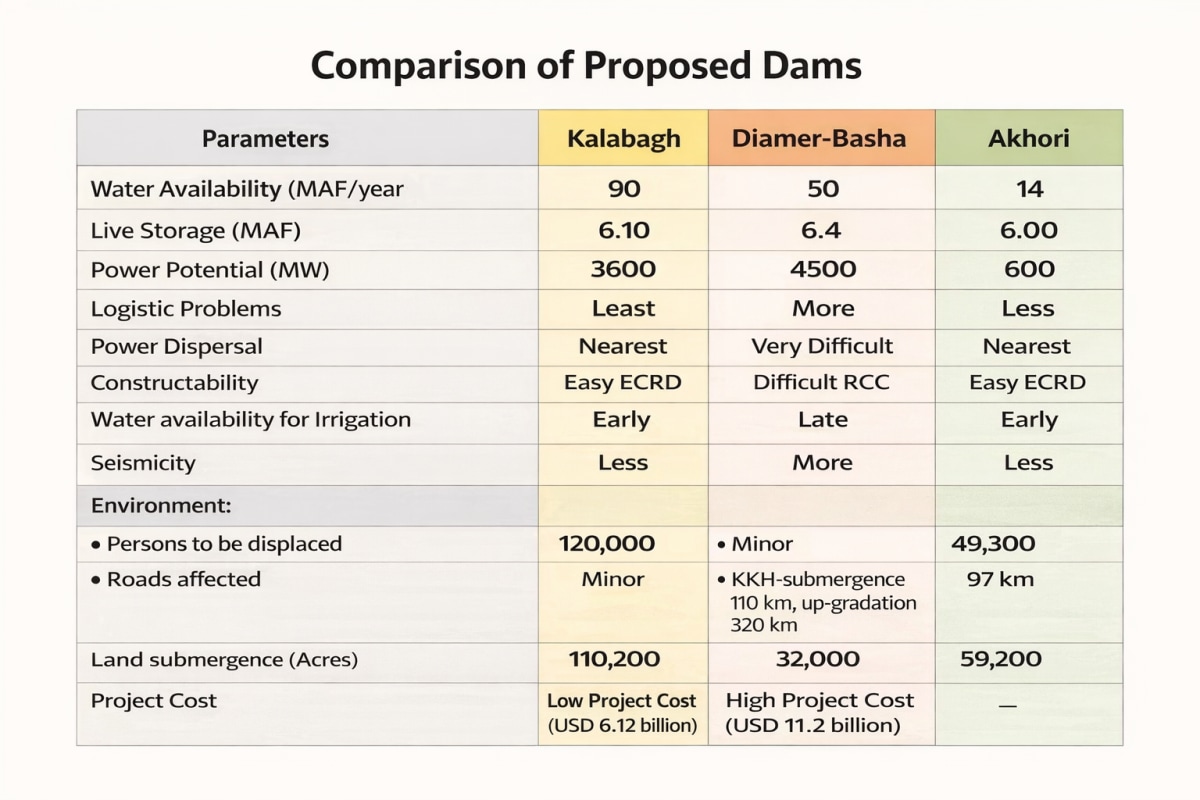
To meet our Water & Power needs, large storages are urgently required. On Indus we have three sites where storage of water is possible. In the case of Diamer-Basha dam, KKH would need 5 to 6 years for its up gradation from Abbotabad to Diamer in a length of about 320 km to make it fit for heavy machinery transport and its raising by about 1000 ft at Chalas/Basham.
Akhori is in its initial phase of planning. Majority of experts are in favour of Kalabagh, the construction of which can be started straightway. Kalabagh Dam is indispensable for better economic future of the country. The issue is as how this objective achieved. The comparison between major dam sites on Indus River is tabulated below which depicts the superiority of Kalabagh Dam over other dams.
6. Key Issues & Criticisms
Despite its technical merits, the Kalabagh Dam has remained one of Pakistan’s most debated infrastructure projects, largely because of deep-rooted mistrust among provinces. Over the years, concerns have been raised, particularly by Khyber Pakhtunkhwa (KPK) and Sindh, about flooding risks, environmental damage, water availability, and population displacement. However, extensive technical studies and hydrological analyses present a factual picture that differs significantly from these apprehensions as explained below.
a. KPK’s concerns and facts on Kalabagh Dam
In Khyber Pakhtunkhwa, fears center on the possibility that a repeat of the historic 1929 flood could worsen flooding in Nowshera. Studies show, however, that the backwater effect of the Kalabagh reservoir would extend only up to Attock which is around 35 kilometers downstream of Nowshera. It means water levels in the city would remain unaffected even during extreme floods. In fact, coordinated operation with Tarbela Dam could help reduce flood intensity.
Similarly, concerns about waterlogging and salinity in the plains of Mardan, Pabbi, and Swabi are not supported by ground-level data, as these areas lie well above the reservoir’s maximum conservation level. Lowest ground levels at Mardan, Pubbi and Swabi area are 970,960 and 1000 ft (AMSL) respectively as compare to the maximum conservation level of 915 ft (AMSL). Regarding population displacement, project plans clearly provide for full compensation at market rates for land, homes, trees, and other affected assets.
b. Sindh’s concerns and facts on Kalabagh Dam
Sindh’s reservations are broader, touching on water scarcity, ecological damage, and impacts on agriculture and fisheries. Critics argue that there would be no surplus water to fill the reservoir and that Sindh could face desertification. In contrast, water balance studies confirm that even after mandatory downstream releases, about 29.26 MAF of water would remain available for storage, ultimately increasing Sindh’s share of regulated water supplies. Fears about diversion through high-level canals are also unfounded, as no such canals were proposed in the project design. Concerns over reduced Sailaba cultivation are addressed by the fact that flood peaks exceeding 300,000 cusecs would still flow downstream, sustaining riverine agriculture.
Environmental issues such as sea-water intrusion, mangrove degradation, and reduced fish production below Kotri have also been closely examined. Findings indicate that the main aquifer in the region is already saline, making reduced river flows largely inconsequential. Mangrove forests in the Indus Delta consist mainly of salt-tolerant species capable of surviving seawater conditions, and no conclusive scientific evidence has established that fish production would decline due to the project.
Overall, while provincial concerns reflect genuine anxieties, the factual evidence from decades of studies suggests that many of these fears are either overstated or unsupported. Bridging the gap between perception and evidence remains the real challenge in moving the Kalabagh Dam debate forward.
7. Current Status (2026)
As of early 2026, the Kalabagh Dam remains unbuilt and largely shelved:
- In 2025, a Senate panel recommended removing Kalabagh Dam from federal planning proposals due to its continued controversy.
- The most recent official planning documents indicate it is no longer a priority government project.
- Other dams like Dasu, Diamer-Bhasha, and Bhasha Dam are currently being developed to tackle water storage and hydropower deficits.
Despite periodic calls for revival by political figures, no consensus has emerged that would enable construction to proceed.
8. Conclusion
The Kalabagh Dam project represents both a major opportunity and a major controversy for Pakistan. Supporters believe it could play a key role in securing the country’s water and energy needs, while opponents fear environmental damage, displacement of communities, and increased political tensions. As Pakistan faces growing pressures from climate change, rapid population growth, and worsening water crisis, the debate over Kalabagh highlights a deeper issue: can large national projects succeed without public trust, unity among provinces, and respect for the environment? This project’s journey from blueprint to battleground offers vital lessons for future infrastructure planning in Pakistan and beyond.
9. Recommendation Under the Present Circumstances
Kalabagh Dam Project (KBD) stands ready for implementation since 1988. Delay in its implementation has hit the national economy hard in every sector. For reducing dependance on very costly thermal power and saving foreign exchange, it is recommended that Kalabagh Dam Project be implemented without any further delay only as Power Project instead of multipurpose dam. It would be a Run-Of-River project which would generate 3600MW of power and would not supply any water for irrigation to any province. It will maintain the present position of full out flows below Kotri to Sea.
Implementing KBD as a “Power Project” offers a pragmatic and nationally unifying solution, strengthening energy security, conserving precious foreign exchange, stimulating economic growth, and providing substantial relief to the people of Pakistan, without altering inter-provincial water allocations.
“Nations that protect and manage their natural resources do not borrow strength from the future, they build it.”
References
https://pecongress.org.pk/images/upload/books/688-KALABAGH.pdf
https://www.dawn.com/news/1773542
https://climate-diplomacy.org/case-studies/kalabagh-dam-conflict-pakistan
https://www.paradigmshift.com.pk/kalabagh-dam/
https://jdss.org.pk/issues/v2/2/cost-benefit-analysis-and-technical-viability-of-kalabagh-dam.pdf
FAQs
Is Kalabagh Dam approved?
No. The project has not received unanimous provincial approval and is currently not part of active government planning.
Why is Sindh against Kalabagh Dam?
Sindh fears reduced downstream water flow, increased salinity, and damage to the Indus Delta ecosystem.
How much electricity would Kalabagh Dam produce?
Approximately 3,600 megawatts, making it one of Pakistan’s largest potential hydropower projects.
Is Kalabagh Dam dead?
Politically, yes — for now. Technically, the project remains feasible but inactive due to lack of consensus.