Analysis of Water Resources of Pakistan: Challenges and Pathways to Sustainability
Explore the water resources of Pakistan, the challenges of water scarcity, and sustainable development strategies for a secure water future.

1. INTRODUCTION
Pakistan is an agriculture country which is located in arid to semi-arid region where average annual rainfall varies from 100mm to 750mm. 90% of available water is being consumed in agriculture sector, 3% for domestic use and 7% in industrial sector. Pakistan has three main sources of water which include surface water, groundwater and precipitation. Pakistan receives 145 MAF average annual flows from surface supply, 50 MAF is groundwater abstraction and 10 MAF is rainfall contribution.
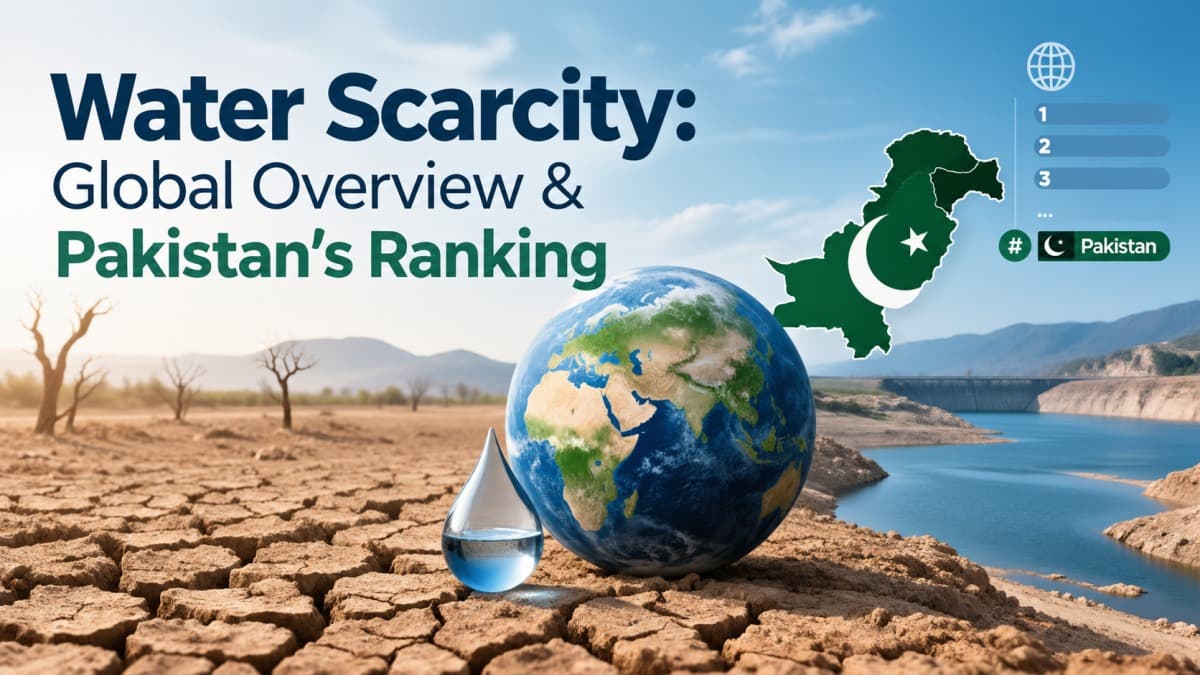
Pakistan’s population is 230 million which has increased by 2.6% since 1970 due to which per capita water availability has reduced from 5260m3 in 1950 to about 1000m3. Pakistan is at the threshold of being water scarce country and this situation may further aggravate. Therefore, sustainable development of water is the dire need of the hour and should be given the top priority. Failing this, it will be serious detriment to our stagnating economy largely based on agriculture. Sustainable development of water could be achieved by water resource development and efficient water management.
2. SURFACE WATER RESOURCES
2.1 Availability of flows
Pakistan receives 145 MAF flows annually from western rivers. These flows are measured at three rim station, Indus at Kalabagh, Jhelum at Mangla and chenab at Marala. Indus contribution is 92 MAF, Jehlum 22 MAF and chenab 26 MAF. Canal head withdrawals are 105 MAF whereas 10 MAF is system loss and remaining 30 MAF directly goes to sea unutilized. From canal head withdrawals only 61 MAF reaches at farm gates whereas remaining is lost in conveyance system like canal, distributaries and watercourses.
There is large seasonal variability of flows. Pakistan receives 80% of its flows during 100 days and remaining 20% flows during 265 days which result in huge difference in supply and demand. Hence storage is very crucial to sustainable development. Without water security, food security cannot be ensured. To ensure food and water security, Pakistan need to enhance storage capacity of water and its optimal use.
2.2 Existing Storage
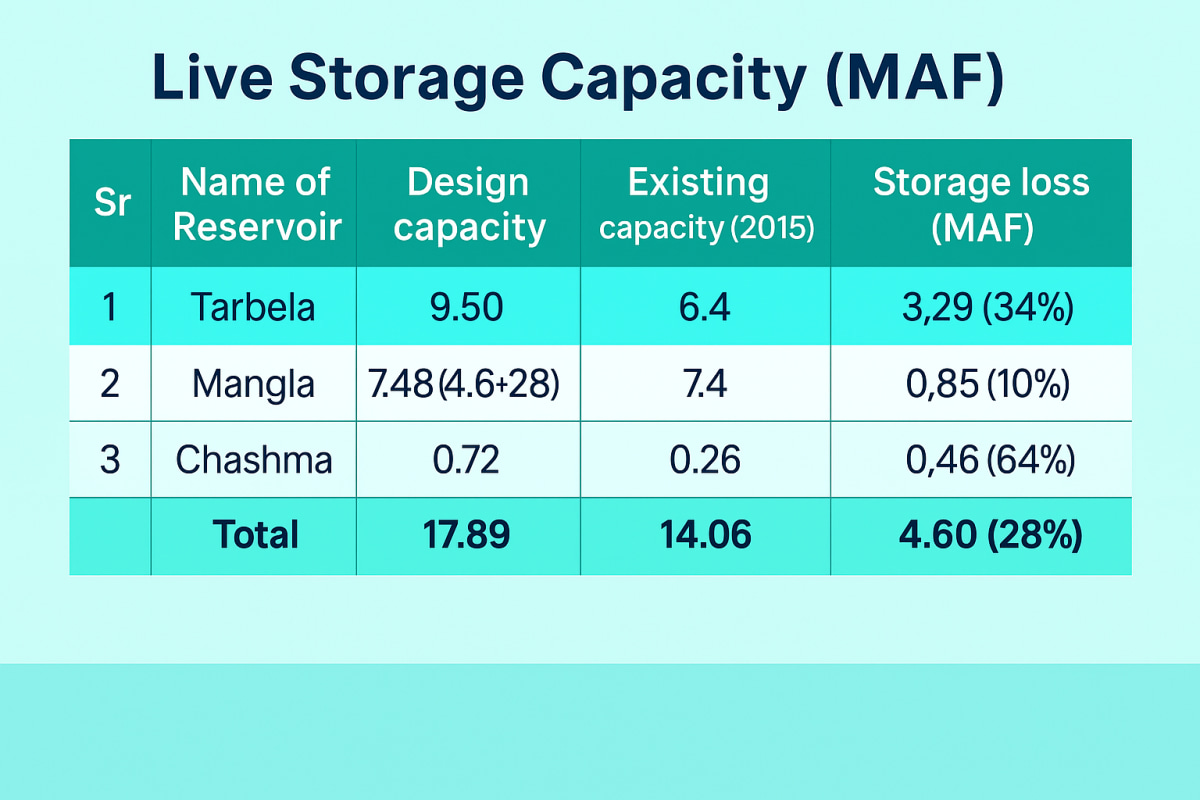
Pakistan hardly stores 10% of surface flows against world average of 40%. Pakistan has three major storages Terbela, Mangla and Chashma. Terbela and Mangla dams were built as Indus Basin Replacement Work. Design capacity of these storages was 18 MAF which has now reduced to 14 MAF due to sedimentation. It was planned in 1960 that Pakistan should progressively building additional reservoirs to compensate for sedimentation losses to meet additional storage need of development. PieterLieftinck in the world Bank’s report on development of Pakistan’s Water Resources had recommended to build a large size reservoir every decade for the foreseeable future. As such during last four decades Pakistan should have added about 24 MAF of storage capacity. Unfortunately, Pakistan has failed in this regard. The detail of existing storages is as below
2.3 Storage potential
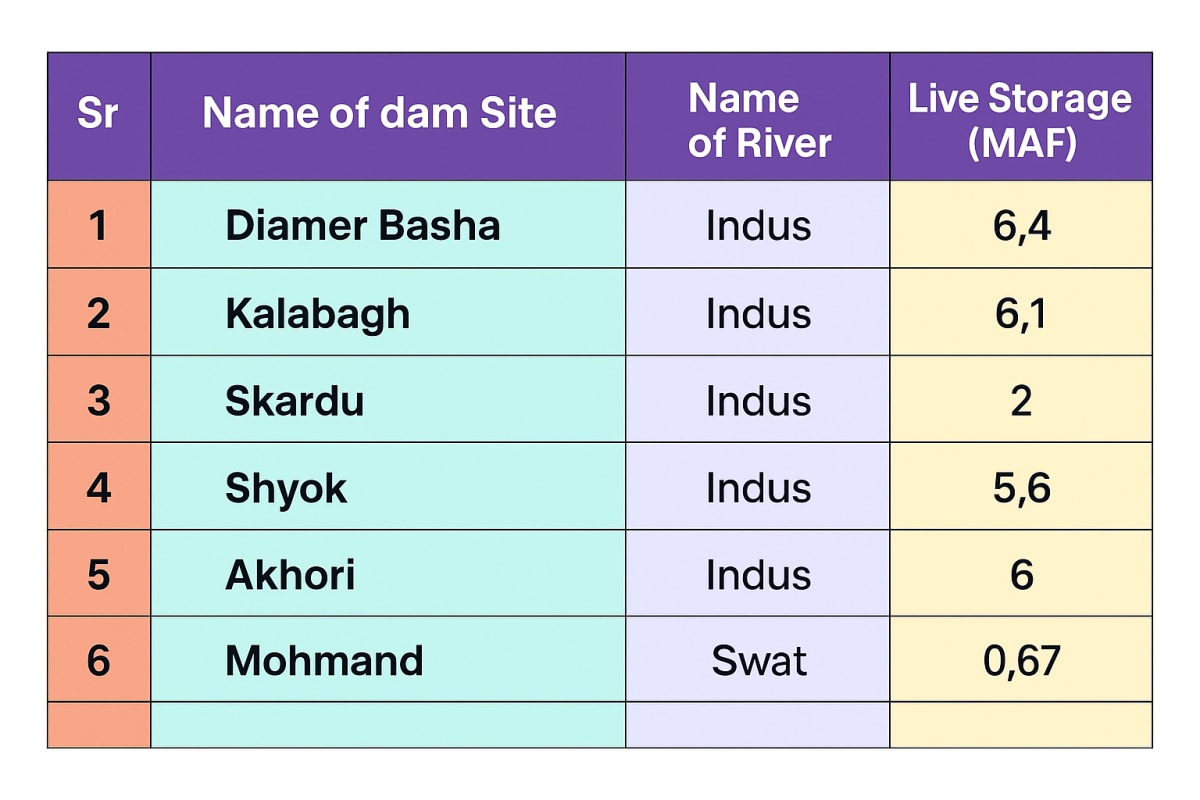
Pakistan has not built any major storage after Terbela and Mangla in spite of having a huge storage potential. On River Indus, the other sizeable storage sites in addition to Terbela are Kalabagh dam, the last site before the river debouches into plains. About 300 km above Tebela is Diamer basha site. There is storage site of about 6 MAF on river Shiger. In addition, there is off-channel storage on river Indus is Akhori dam site. Similarly on river Jehlum, there is an off-chanel storage site of Rohtas dam. There is no site on river Chenab except a small storage near Chiniot. There are about 150 small to medium dams in Pakistan for domestic water supply and local agriculture use. The detail of major storage potential is as below
 There are 14 hill torrent areas with an average potential of 23 BCM (mnsuam.edu.pk). Most of the hill torrents descend down at steep gradient from Koh Hindu Kush and Kirthar range and damage D.G Khan canal, Kachi Canal and other infrastructure in D.I khan and D.G Khan district before joining river Indus on right bank. The runoff in these hill torrents need to be harnessed by constructing storages on them and utilizing the regulated flows for the development of 5 million hectares of culturable wasteland in the hilly areas of Hazara, Bannu, D.I Khan, D.G khan, kachi Canal, Kirthar range, Karachi area, Sehwan area, Petaro and vast areas in Balochistan.
3. GROUNDWATER RESOURCES
3.1 Availability
Pakistan primary ground water resource is in the irrigated areas of the Indus Basin, while the secondary source is the area outside the Indus Basin. Indus basin is underlain by unconfined aquifer covering about 40 million acres (MA) of surface area of which 15 MA is fresh and 25 MA is saline. The aquifer receives its direct recharge from natural precipitation, river flows and continued seepage from canal, distributaries and watercourses. Indus basin aquifer ranked as the 2nd most over stressed underground water reserve in the world. It contributes more than 50% in agriculture sector, around 70% in domestic use and 100% in industrial sector. The safe yield of groundwater is 53.3 MAF (Punjab 40 MAF, Sindh 10 MAF, KPK 2.4 MAF and Balochistan 0.9 MAF. The groundwater potential and use in AJK is very limited as compare to others provinces.
3.2 Over Exploitation
Unregulated and uncontrolled use of groundwater is diminishing the relative accessibility. Depth to water table has decline in many areas of the Indus Basin which is evident that there is serious imbalance between abstraction and recharge. Due to excessive urbanization and construction of impermeable membrane over the natural strata, rate of groundwater extraction is much higher than its recharge rate. Many tubewells have gone out of production whereas production of remaining wells has reduced below 50% in many areas. Excessive mining of aquifer in fresh groundwater area has resulted in falling water tables and groundwater has become inaccessible in 15% and 20% of the irrigated area of Punjab and Baluchistan respectively.
3.3 Deterioration of Quality
Quality of groundwater in Indus Plain varies widely, both spatially and with depth. Around 77% (10 MA) area of Punjab has access to fresh groundwater. Saline water is mostly encountered in central doab area and Cholistan area in southern Punjab is well known for highly brackish water unfit for drinking purpose. In Sind province, about 28% of area has access to fresh groundwater. Large areas are underlain by poor quality of groundwater. In Sindh, the area of fresh ground water is confined to a narrow strip along the river Indus. Excessive pumping of this layer is causing salt water intrusion into fresh groundwater areas which resulted in abandoning of about 200 public tubewells located in fresh groundwater zones of Sindh province.
4. APPROACH TO SUSTAINABILITY OF WATER RESOURCES
Water is at the core of sustainable development and is critical for socio-economic development, healthy ecosystem and for human survival itself. Water can pose a serious challenge to sustainable development but managed efficiently and equitably, water can play a key enabling role in strengthening resilience of social, economic and environmental systems in the light of rapid and unpredictable changes. Hence sustainability of water resources is crucial to all other sustainable development in the country. Sustainability of water resources could be achieved by,
4.1 Water Resources development
Amid prevailing challenges of increasing population, climate change, water scarcity and food insecurity, Pakistan need additional storage of 40 MAF by 2050 which is only possible by constructing large storage dams on top priority basis which will help in conservation of unutilized water of 30 MAF below Kotri which will not only result in food and water security but also for flood regulation to avoid extensive loss of life and property.
4.2 Water Conservation
Construction of dams require huge financial resources. Amid dwindling economic condition, focus should be given on conserving water to achieve the short and medium term goals which is possible by rainwater harvesting, increasing conveyance efficiency, on farm water management, efficient use of water in every sector, waste water treatment etc.
4.3 Effective groundwater management
The groundwater use has almost reached the sustainable limit. Increasing population and industrialization has put this precious resource under severe stress. In IBIS, groundwater is usually used in conjunction with surface water which helps the farmers in decreasing the salinity of irrigation water in an attempt to avoid soil salinization. In most of the canal command areas, conjunctive use of ground water and surface water is equally practiced in head and tail end of canal system. One of the key disadvantages of this unmanaged conjunctive use is that upstream areas are subjected to waterlogging whereas tail end users are aggravating their salinity problems due to bad quality of the groundwater. Therefore, effective conjunctive use should be encouraged that will allow a combination of surface and groundwater to farmers in such a way that equity in availability of water of acceptable quality is ensured all along the channel. Pakistan must learn that development of groundwater resources without proper planning and management strategy has paid back very badly. Therefore, Pakistan needs a serious debate about whether to pump their aquifer to maximum and face the consequences thereafter. Or be more proactive now, better manage abstraction and invest in recharge today. Protecting groundwater through management and technical measures like regulatory framework, water licensing, artificial recharge especially for threatened aquifer and should adopt Integrated Water Resource Management (IWRM) concept.
4.4 Public Awareness
The participatory approach involves raising awareness of the importance of water among policy makers and general public. The awareness campaign regarding water issues, self-regulation, groundwater monitoring and management interventions need to be started through electronic and print media. Water conservation topics should be the part of syllabus at primary, secondary and tertiary level education system. Media and non-government organization (NGOs) can play pivotal role.
4.5 Water Pricing
Past failure to recognize the economic value of water has led to wasteful and environmentally damaging uses of the resources. Managing water as an economic good is an important way of achieving efficient and equitable use and of encouraging conservation and protection of water resources.
5. CONCLUSION
Pakistan’s water resources form the backbone of its agriculture-based economy, yet these resources are under immense pressure from population growth, climate variability, unregulated groundwater abstraction, and insufficient storage capacity. The country currently stores only about 10% of its surface water flows, far below the global average, while the per capita water availability has fallen to a critical level of around 1,000 m³, a threshold for water scarcity.
Groundwater, once a reliable buffer, is now overexploited and deteriorating in quality due to salinity, contamination, and poor recharge practices. The sustainable development of Pakistan’s water resources is no longer an option but a national imperative. Ensuring water and food security, maintaining ecological balance, and supporting socio-economic growth all depend on effective water management. Without comprehensive reforms in storage infrastructure, efficient utilization, and groundwater governance, the country risks facing severe water crises that could hinder its progress toward sustainable development goals (SDGs).
REFERENCES
https://iwaponline.com/jwcc/article/15/10/4919/105078/Water-resources-in-Pakistan-a-comprehensive
https://pecongress.org.pk/images/upload/books/4-Dr.%20Allah%20Bakhsh%20Sufi.pdf
https://pide.org.pk/research/water-resources-and-conservation-strategy-of-pakistan/
https://www.sciencedirect.com/science/article/pii/S258891252300019X
https://file.pide.org.pk/pdf/PDR/207/Volume4/997-1009.pdf
FAQs
Which country has the best water management?
Switzerland has the highest possible urban water treatment quality and, according to the World Health Organization, it has the best tap water quality in the world. How is it possible? Switzerland has strict water treatment standards and superior natural resources (underground water, rainfall, natural springs).
Which country has the biggest water problem?
The five most water-stressed countries are Bahrain, Cyprus, Kuwait, Lebanon, Oman and Qatar.