Why On-Farm Water Management Is the Key to Pakistan’s Agricultural Future
Discover why On-Farm Water Management (OFWM) is essential for securing Pakistan’s agricultural future.How OFWM offers a practical and sustainable solution for a water-stressed nation facing rising climate challenges.

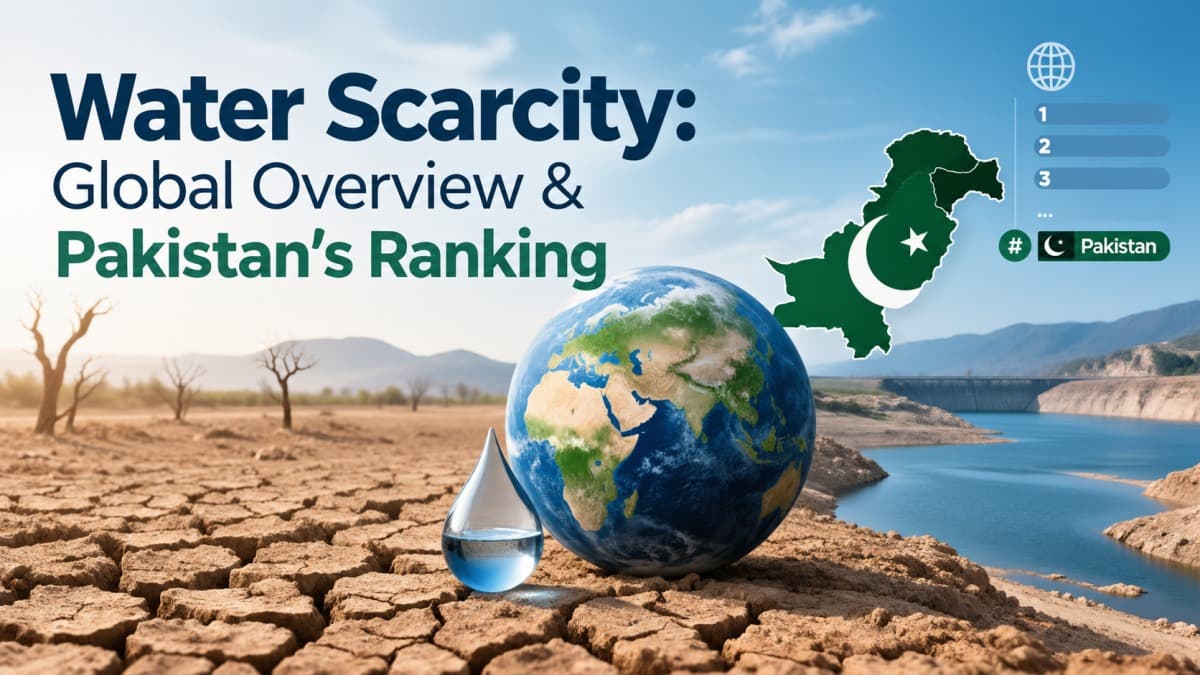
In 1950, per capita water availability in Pakistan was approximately 5,260 m³, which has now decreased to 850 m³ and is expected to reach the water scarcity threshold of 750 m³ by the end of 2025.
Climate change, population growth, over-exploitation of groundwater, inefficient irrigation practices, limited storage capacity, outdated irrigation infrastructure, and weak governance are the primary drivers of the water crisis in Pakistan.
Pakistan is an agricultural country where 90% of available water is used in the agriculture sector, 3% in the domestic sector, and 7% for industrial use. This clearly shows that improving water-use efficiency in agriculture can play a key role in protecting the country from becoming water-scarce. This is where On-Farm Water Management (OFWM) becomes essential.
In this blog, we will explore:
- What on-farm water management actually means
- Why it is critical for Pakistan’s food security and economy
- Research-based evidence from Pakistan showing how better water management boosts yields and conserves water
- Practical recommendations for farmers and policymakers
1. Pakistan’s water reality: more pressure, less reliability
Pakistan is a single-basin country that receives about 80% of its surface water supplies from outside its borders. Its location in a heat-surplus zone makes it more vulnerable to climate change. Extreme weather events, changed and unpredictable precipitation patterns, more frequent and intense floods and droughts, retreating glaciers, and Glacial Lake Outburst Floods (GLOFs) are placing mounting pressure on already limited water resources and making water availability increasingly unreliable.
A few key facts set the stage:
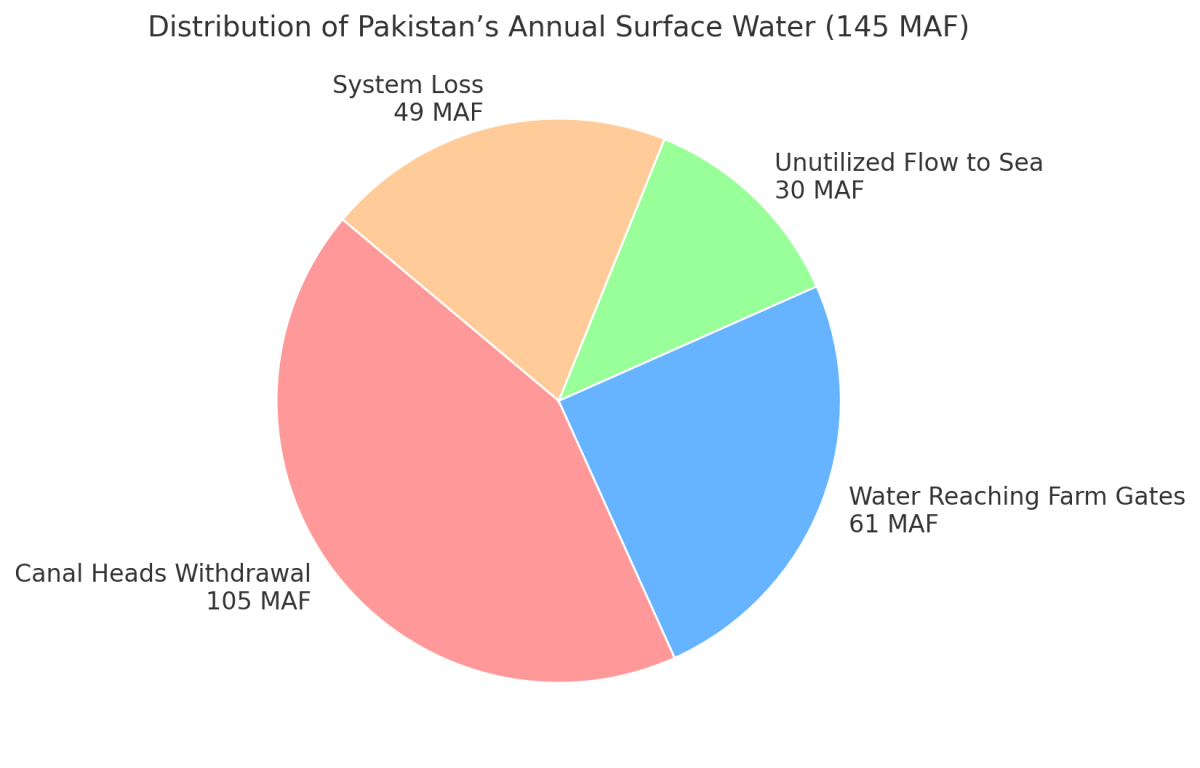
- Pakistan receives roughly 145 MAF of surface water annually. Of this, 105 MAF is canal heads withdrawal, 61 MAF reaches at farm gates, and about 30 MAF goes to sea unutilized; the remaining is system loss.
- Pakistan receive 80% of its supplies within 100 days, while the remaining 20% are distributed across the other 265 days, creating a large mismatch between supply and demand.
- Pakistan stores only about 10% of its surface supplies, compared to the global average of 40%. It has storage capacity for just 30 days, amounting to around 14 MAF.
- Over-extraction of groundwater has placed this vital resource under severe stress, as withdrawals have already reached the safe yield limit of 55 MAF.
- Misuse and mismanagement of water persist across all sectors.
Given these challenges, the development and effective management of water resources is urgently needed. However, developing new water resources requires significant time and financial investment. Therefore, the most realistic and immediately actionable path forward is to improve the efficient management of existing water, particularly at the farm level.
2. What is on-farm water management (OFWM)?
On-Farm Water Management (OFWM) covers all the practices and technologies that help farmers:
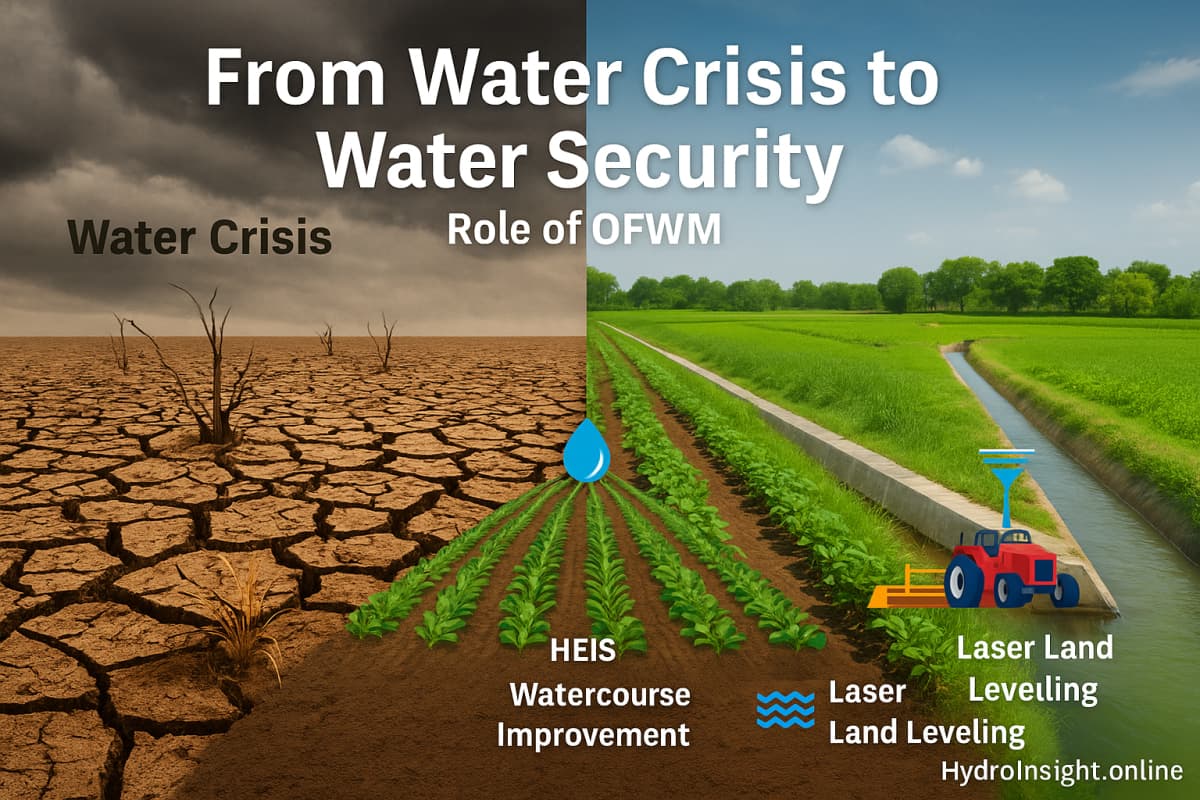
- Convey water from the canal outlet to the field efficiently. For example, watercourse improvement helps in achieving this objective.
- Apply water to the crop in the right amount, at the right time, in the right way. High Efficiency Irrigation Systems (HEIS) ensure application of water according to planned schedule.
- Manage soil and cropping patterns so that every unit of water produces higher yield and income
On Farm Water Management (OFWM) focuses on maximizing water productivity, reducing wasteful use of water, and ensuring sustainability.
In Pakistan, OFWM typically includes:
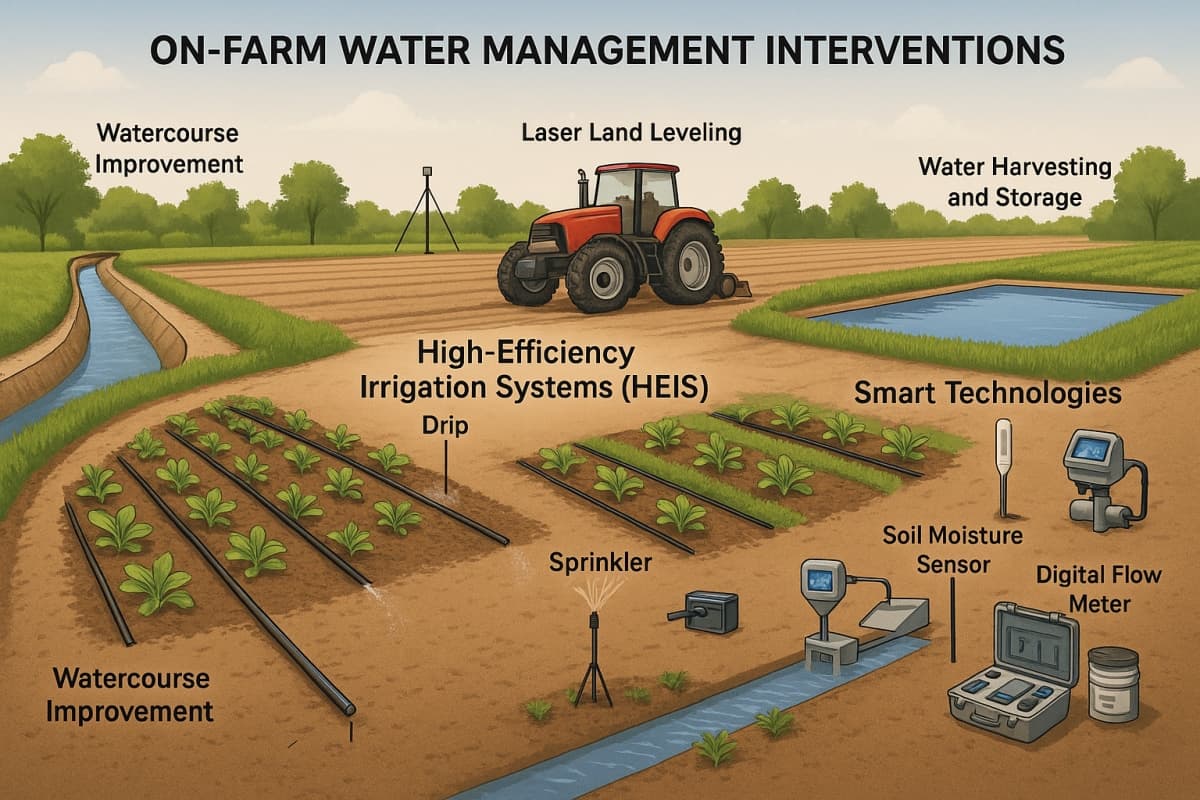
- Watercourse improvement & lining
- Laser land leveling (precision land leveling)
- High Efficiency Irrigation Systems (HEIS) like drip and sprinkler
- Water Harvesting and Storage at farm level through construction of water storage pond
- Smart technologies (soil moisture sensors, smart flumes, digital flow meter, soil & water testing kits). Using these technologies and tools to improve Water Use Efficiency.
These interventions have proven track record of saving significant amount of water and improving the yield and produce quality. In addition, they support sustainability and enhance resilience in agriculture under prevailing challenges of climate change and growing water scarcity.
3. The Vital Contribution of On-Farm Water Management to National Prosperity
The above-mentioned interventions have significantly contributed in enhancing conveyance, application and water use efficiencies at farm level along with increasing crop yield. Let’s discuss their contribution in detail:
3.1 Watercourse improvement & lining
The program has delivered remarkable impacts across the agricultural landscape. Each year, it saves an impressive 229 acre-feet of water in regular watercourses, 164 acre-feet in additional watercourses, and 55 acre-feet across irrigation schemes. This enhanced efficiency has contributed to a 9% rise in cropping intensity and a substantial 31% boost in crop yields, enabling farmers to earn higher profits and improve their livelihoods. Beyond productivity gains, the program has curbed water theft, strengthened dispute resolution mechanisms, and fostered greater equity by ensuring fair and reliable water access for all farmers.
3.2 Laser land leveling
Studies have indicated that a significant (20-25%) amount of irrigation water is lost during its application at the farm due to poor farm designing and unevenness of the fields. This problem is more pronounced in the case of rice fields. Enhancement of water productivity at farm level is the most appropriate solution to redress water scarcity. Light Amplification by Stimulated Emission of Radiation (LASER) Land Leveling is the best option for improving water productivity through minimizing water application losses.
- Saves 20–25% irrigation water.
- Ensures uniform seed germination and fertilizer use.
- Boosts yield through better water productivity.
- Cuts water losses on rice fields significantly.
3.3. High Efficiency Irrigation Systems (HEIS)
Experience from systems installed across Pakistan shows that this technology is transforming agriculture in extraordinary ways. Farmers are witnessing up to 50% water savings, more than a 100% increase in crop yields, and fertilizer savings of up to 60%. The technology has also accelerated crop cycles, enabling orchards to mature one to two years earlier and allowing vegetables to be harvested 10–15 days ahead of schedule. This shift has opened doors for crop diversification, created local employment opportunities, and enhanced the value of produce through improved quality. Together, these outcomes highlight the powerful role which modern technology can play in reshaping agriculture and strengthening rural economies.
4. Why On-Farm Water Management is the key to the future
Putting all this together, here’s why OFWM is central to Pakistan’s agricultural future because OFWM interventions addresses the major challenges of water scarcity, food security and climate change.
4.1 It directly tackles water scarcity
For a country like Pakistan, undertaking large-scale projects such as building major reservoirs is challenging, as these initiatives demand substantial financial investment and long construction periods. Given the current financial constraints, farm-level, micro-scale interventions offer a practical and impactful alternative to address growing water scarcity and prevent the situation from worsening. Practices such as watercourse lining, laser land leveling, drip and sprinkler irrigation, and improved irrigation scheduling have been shown in multiple studies to save 15–50% of water at the farm level.
4.2 It boosts yields and ensures food security
Each OFWM intervention shows a win–win situation. Adequate and timely irrigation not only help in saving significant amount of water but also increase the yield of crops from 20–35%. The water saved from OFWM interventions can be used to bring more area under cultivation which ultimately leads to food security.
4.3 It supports climate resilience
Extreme weather events, Intense and frequent flood, prolonged drought and erratic precipitation patterns made the supplies unpredictable and unreliable. On Farm Water Management intervention like water storage ponds, Laser Land Levelling & HEIS provide resilience to counter this challenge of uncertainty.
4.4 It makes national water reforms meaningful
One of the key goals of Pakistan’s National Water Policy is to enhance water productivity under the vision of “More Crop per Drop.” This vision can only be realized if the last mile—the farm—uses water efficiently.
Without OFWM, any savings upstream (in dams or canals) simply get lost in leaky watercourses, uneven fields, and inefficient irrigation practices.
5. What needs to happen next?
5.1 For policymakers & planners
- Scale up OFWM programs, not just big infrastructure
- Allocate more budget and incentives to watercourse lining, laser leveling, and HEIS.
- Prioritize high water-stress districts in Punjab, Sindh, Balochistan, and Khyber Pakhtunkhwa.
- Targeted subsidies, smartly designed
- Adoption of HEIS in Pakistan is very slow as compared to other developed countries. This is because of high upfront cost, limited technical support, and complex designs.
- Need to revise design to make it more economical and suitable to mix-cropping practices.
- Regulate groundwater and solar pumping
- No doubt, the solarization of tubewells has strengthened climate resilience and promoted climate-smart agriculture in Pakistan. However, this intervention must be linked with water quotas, metering, or community-based regulations to prevent the over-extraction of groundwater.
- Invest in extension & local capacity
- Many farmers hesitate to adopt HEIS & smart technologies because they lack technical guidance and trust.
- Strengthen OFWM field staff, farmer field schools, and demonstration plots.
5.2 For researchers & development partners
- Refine technologies for small land holders
- There is a need to customize High-Efficiency Irrigation Systems (HEIS) and indigenize sensor-based technologies so they are suitable for small, fragmented landholdings and mixed cropping systems.
- Focus on economics, not just engineering
- Farmers care about payback period, risk, and labour. So, research should include full cost–benefit and risk analysis.
5.3 For farmers & farmer organizations
- Maintain and improve your watercourse
- Fix leakages, clear weeds, and participate in lining projects where available.
- Consider laser land leveling (even rented service)
- It is often one of the fastest payback investments because it improves both yield and water use in all crops.
- Start small with HEIS
- Use drip or sprinkler first on high-value crops (orchards, vegetables, tunnel farming) where the payback is quickest.
- Irrigate when the crop needs it, not just when water arrives
- Use simple tools (tensiometers, or sensors where available) to check soil moisture.
- Organize as groups
- Farmer organizations or water user associations can jointly invest in laser services, drip systems, and training.
6. Conclusion: The future is decided at the farm gate
Pakistan’s agricultural future will not be secured solely by building storage dams. It will be shaped by how efficiently we manage our existing water resources, especially at the farm level, where substantial losses still occur. If we want a resilient and secure agricultural future, we must make strategic choices, such as:
- Shifting from flood irrigation to improved irrigation practices
- Using smart technologies and sensors to enhance application efficiency
- Regulating groundwater abstraction through metering, community-based rules, and water quotas
Ultimately, the goal is to increase the water productivity through adoption of OFWM interventions. In a country where agriculture depends on over stressed single basin system and a fragile climate, there is no sustainable future without serious investment in On Farm Water Management(OFWM).
References
https://ofwm.agripunjab.gov.pk/
FAQs
What is water management 10 points?
Water management is the planning, development, distribution, and optimal use of water resources to meet present and future human demands. Its importance includes: Ensuring sustainable water supply for domestic, agricultural, and industrial use. Preventing water scarcity and wastage.
What are the 5 uses of water in the farm?
Preharvest water is used for crop irrigation, cooling, frost protection, as a carrier for fertilizers and pesticides, and for washing tools and harvest containers, handwashing, and drinking,