Smart Irrigation in Pakistan: How Soil Moisture Sensors Ensure Food and Water Security
Smart irrigation in Pakistan uses soil moisture sensors to optimize water use, improve crop yields, and strengthen food and water security under climate change.

Introduction
Pakistan is an agricultural country where food production and water availability are deeply interconnected. It is evident from past that without water security, food security can not be ensured. Growing challenges of rapid population growth and climate change are putting both water and food security under high risk. Pakistan has already witnessed rapid decline in per capita water availability from 5250m3 to 850m3. Agriculture sector being the biggest consumer of water nearly 90% of Pakistan’s water resources, making efficient water management critical for national sustainability and survival.
In this context, food and water security has become an important topic for researchers, policymakers, and farmers. Smart irrigation tools like use of soil moisture sensors are emerging as powerful tool that conserve water through optimize irrigation. This approach ultimately strengthens both food and water security in Pakistan.
Understanding Smart Irrigation in Pakistan
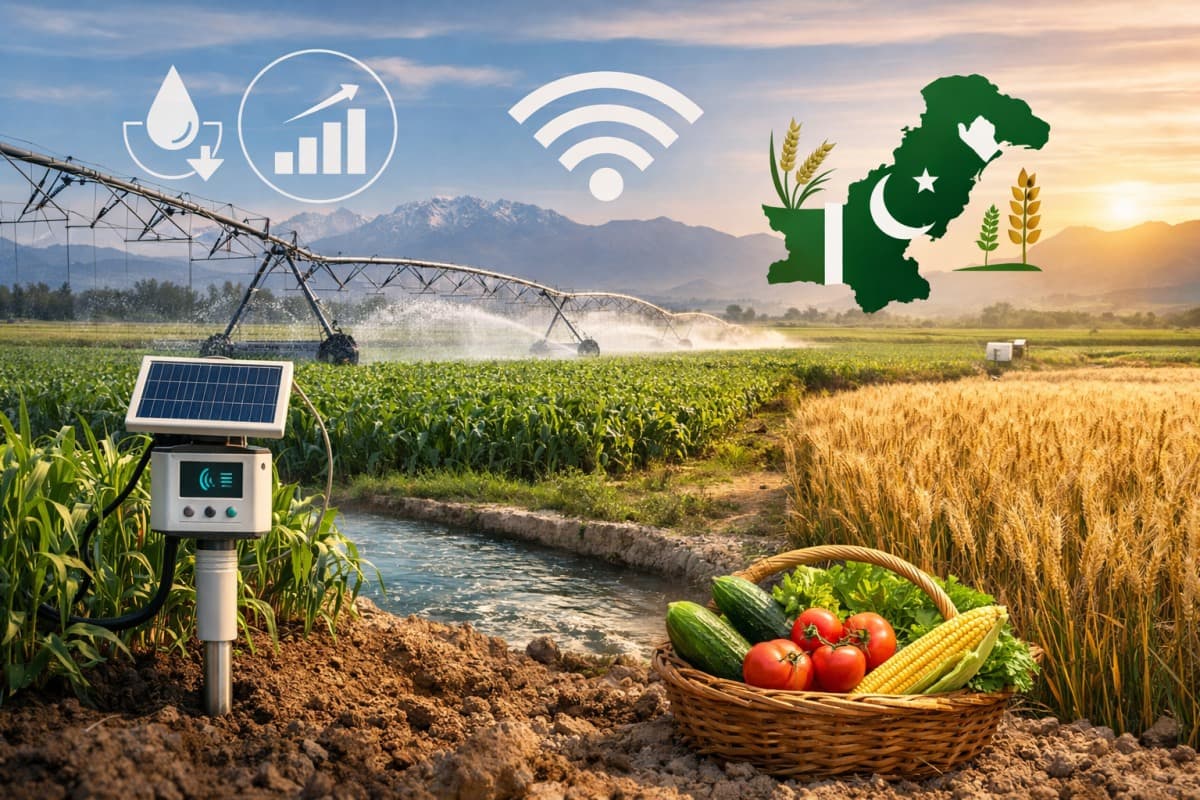
Smart irrigation refers to the use of modern tools and technologies which set data driven decision support system for irrigation scheduling by considering real time soil, crop and climate data. Smart irrigation approach uses soil moisture sensors, ICT base devices and automated systems for efficient use of water at farm level. Unlike traditional irrigation, which relies on fixed schedules or guesswork, smart irrigation uses real-time soil data to determine when and how much water crops actually need. Use of soil moisture sensors help farmers avoid under-irrigation and over-irrigation, maintain optimum moisture condition in soil which lead to better crop yield.
The Water Crisis and Food Security Challenges in Pakistan
Pakistan ranked among top 10 most vulnerable countries to climate change. Climate change results in extreme weather events like intense and frequent flood, long duration drought, glacial retreat, heat waves, change and unpredictable rainfall patterns which not only putting the already limited water resources under sever stress but also leading to food insecurity in Pakistan. Climate change makes water supplies highly unpredictable and widens the gap between supply and gap which threatens agriculture productivity and national food supply.
So, water and food security are one of the most pressing development challenges in Pakistan. Under this situation, smart irrigation and use of soil moisture sensors is not just a technological discussion but a national necessity. Efficient irrigation technologies can reduce water wastage while ensuring consistent crop growth, which is essential for feeding a growing population.
How Soil Moisture Sensors Work in Smart Irrigation
Soil moisture help determine the real-time moisture content in the soil and send data to farmers via mobile apps or control systems. This approach determines the exact irrigation requirement of crops and develops data driven decision support system to set irrigation schedule on real-time basis.
Key functions include:
- Real-time soil moisture monitoring
- Automated irrigation scheduling
- Data-driven decision-making
Moreover, modern soil moisture sensor systems even provide alerts indicating when irrigation is required, allowing farmers to make informed and timely decisions. These technologies provide sustainable and resilient solutions that support climate-smart agriculture across diverse and changing climate conditions.
Role of Soil Moisture Sensors in Water Conservation
Traditional irrigation methods often result in excessive water use due to lack of precise monitoring. Being informed about the correct water need and usage is a crucial aspect of agriculture. Too much water leaves less growth space for the roots by putting the crop under aeration stress whereas less than required water leaves the crop in a growth strain.
Field studies in Pakistan show that sensor-based irrigation can reduce water consumption by 20–30% while improving crop yields simultaneously. Moreover, sugarcane farmers who used these installed soil moisture sensors saved up to 35% on irrigation costs and increased the quality of their crop yield(lums.edu.pk).
Therefore, soil moisture sensors directly support sustainable water management by:
- Preventing over-irrigation and under-irrigation
- Reducing groundwater depletion
- Improving irrigation efficiency
Impact of Soil Moisture Sensors on Crop Yield and Food Security
Food security linked with the enhanced agriculture production which depends on optimum moisture conditions in soil. Soil moisture sensors improve crop health by maintaining optimal soil moisture levels, which is crucial for plant growth. It has been established that farms using soil moisture sensors have experienced 15–20% increase in crop yields.
These results were observed in multiple farming regions where farmers shifted from traditional irrigation to sensor-based systems.
This demonstrates that use of Soil Moisture Sensors is not just about conserving water but also about boosting agricultural productivity and ensuring a stable food supply.
Type of Soil Moisture Sensors
1. EnviroSCAN
EnviroSCAN accuratley monitor soil moisture, salinity, temperature and humidity at depths from 0.5 metres to 30 metres (100 feet). EnviroSCAN is proven instrumental in achieving water savings of 30-50% and significant improvements in crop yield and quality.
2. Chameleon Wi-Fi Reader
It uses colour LED’s to provide the farmer with the information required to make a decision regarding irrigation. The reader measures a sensor array comprised of three Chameleon Soil Water Sensors and one temperature and ID sensor. The three soil water sensors are typically buried at different depths in the field (eg. 20, 40 and 60cm). The temperature sensor is recommended to be buried at the middle level for temperature compensation of the soil moisture readings.(VIA.FARM).
3. FullStop Wetting Front Detector
The FullStop Wetting Front Detector shows how deep-water infiltrates into the soil after irrigation. Moreover, it also tells about the movement of plant nutrients and salt through the soil can be monitored(VIA.FARM).
4. Handy Soil Moisture Meter
The meter is used by inserting its probe vertically into the soil to the desired root-zone depth, ensuring good contact between the sensor and the soil. After insertion, the moisture reading is displayed either on a digital screen or an analog scale, depending on the model.
Adoption of Smart Irrigation in Pakistan
Pakistan has already started adopting soil moisture sensor technology through pilot projects and research programs. The On Farm Water Management (OFWM) Punjab started pilot project “Pilot Testing of Innovative Technologies to Improve Water Use Efficiency” in the command area of Lower Bari Doab Canal (LBDC). The project aim was to enhance Water Use Efficiency (WUE) of flood irrigation by utilizing soil moisture sensors and other improved irrigation practices like Alternate Wetting and Drying (AWD) (agripunjab.gov.pk).
In addition, International Water Management Institute (IWMI) has installed hundreds of sensors across districts such as Okara, Chakwal, and Mansehra to optimize irrigation practices. (IWMI). Farmers using these sensors reported:
- Reduction in irrigation frequency
- Lower energy and water costs
- Better crop management
These examples reinforce the importance of Smart Irrigation in Pakistan: How Soil Moisture Sensors Ensure Food and Water Security as a practical, field-tested solution.
Challenges in Implementing Smart Irrigation in Pakistan
It has been observed during implementation of Pilot project that despite their enormous benefits, some barrier limits the adoption of soil moisture sensors in Pakistan:
· Lack of technical knowledge
· Lack of farmer awareness
· High initial cost
· Risk of theft
However, government subsidy programs and extension services can overcome these barriers and accelerate the adoption of smart irrigation technologies nationwide.
Future of Smart Irrigation in Pakistan
Being a country, already struggling with issues of climate change and water scarcity, adoption of smart irrigation is no longer an option but a necessity to ensure water and food secure future for Pakistan.
Experts believe that scaling up sensor-based irrigation can improve resilience to climate change along-with judicious use of water while easing pressure on declining water resources.
This clearly highlights the relevance of soil moisture based Smart Irrigation in achieving sustainable development goals.
Conclusion
From above facts, it is quite clear that Smart Irrigation represents a transformative approach to modern agriculture. Soil moisture sensors conserve scarce water resources and increase crop yields by enhancing water-use efficiency. Moreover, strengthen national food and water security.
As Pakistan faces growing water scarcity and food demand, adopting smart irrigation technologies is no longer optional but essential. By investing in soil moisture sensors, training farmers, and promoting digital agriculture, Pakistan can secure its water resources, enhance agricultural productivity, and build a sustainable and food-secure future.
References
https://eos.com/blog/soil-moisture-sensor/
https://wit.lums.edu.pk/soilmoisturemonitoring
https://www.iwmi.org/blogs/smart-irrigation-transforms-water-management-for-farmers-in-pakistan/
https://extension.umn.edu/irrigation/soil-moisture-sensors-irrigation-scheduling
https://agripunjab.gov.pk/wm-pilot-innovative-tech
FAQs
How does climate change increase the need for smart irrigation in Pakistan?
Climate change result in extreme weather events like intense and frequent flooding, long duration drought, erratic rainfall pattern which make water availability highly unpredictable and crop highly vulnerable to climate variability. That’s why adoption of smart irrigation is not just an option but a necessity.
Do soil moisture sensors increase crop yields?
Use of soil moisture sensor help preventing over-irrigation and under-irrigation and maintain optimum moisture level in soil by developing data driven decision support system. These measures ultimately enhance crop yield.
What is the future of smart irrigation in Pakistan?
The future of smart irrigation in Pakistan looks promising. Smart irrigation linked Pilot projects and research initiative have developed confidence among farming community regarding the adoption of advance irrigation practices to secure water and food.