Green Pakistan Initiative Canal Project: Opportunities, Challenges and Critical Analysis
Green Pakistan Initiative Canal Project: Explore its benefits, Sindh concerns, water crisis, Cholistan challenges, and future sustainability risks.

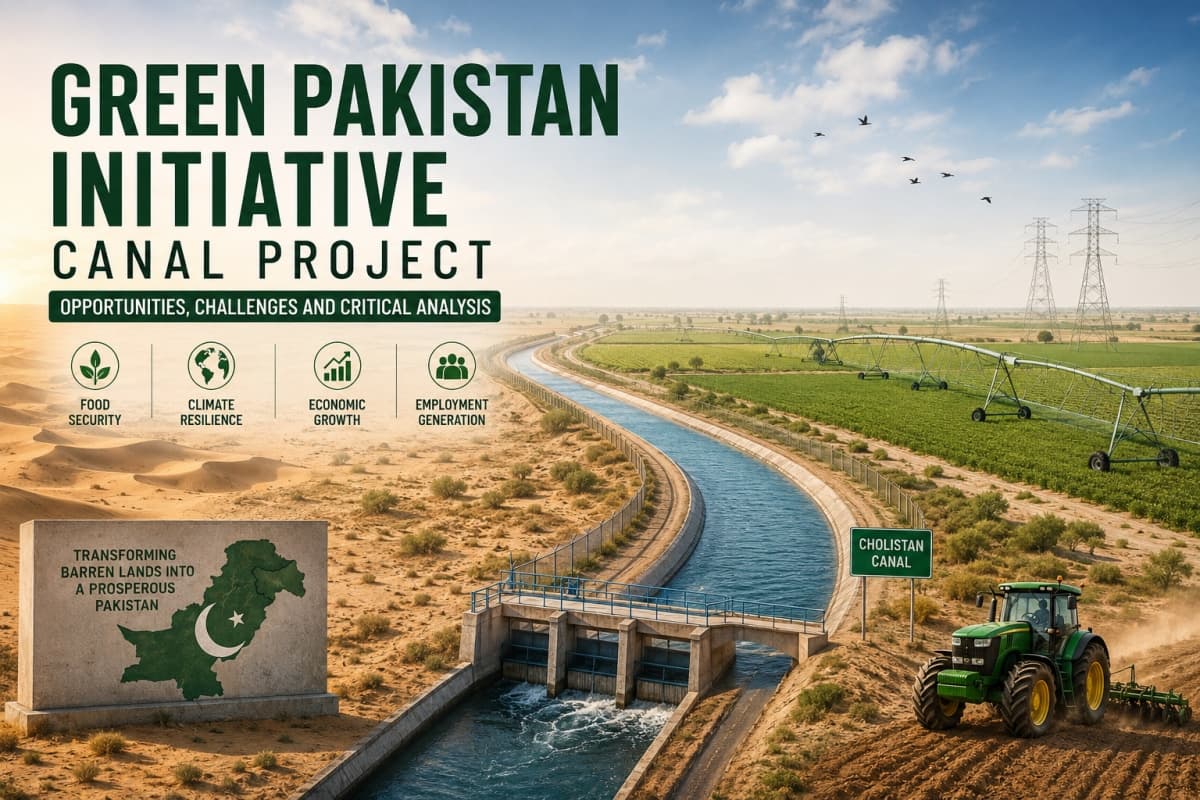
Introduction
Agriculture is the backbone of Pakistan’s economy, contributing nearly 20 percent of its gross domestic product (GDP) and providing 40 percent of its employment share. Pakistan’s 52.8 million acres of farmland is cultivated by its over 10 million farmers. Many experts hold the view that small farm sizes (average 5.1 acres) and traditional farming methods put the country’s agriculture sector on the wrong side of the economies of scale paradigm. Resultantly, it is neither able to meet domestic demands nor can it compete in export markets, which are dominated by countries with high-tech corporate farms of very large sizes. Green Pakistan Initiative aimed to reverse this.
The Green Pakistan Initiative (GPI) canal project is a $3.3 billion agricultural development plan launched in 2023 to transform millions of acres of barren land in Punjab, Sindh, and Balochistan into fertile, modern farming areas. The project is a joint effort of the government of Pakistan and the Pakistan Army, being implemented by a company named Green Corporate Initiative (GCI) Private Limited. GCI identifies and acquires culturable wastelands of the provinces on a 30-year lease under joint venture agreements and allocates land parcels to the interested investors to undertake corporate farming. The minimum size of land parcel that GCI offers is one thousand acres.
The key projects include construction and upgradation of six canals including Cholistan Canal, Greater Thal Canal, Thar Canal, Rainee Canal, Kachi Canal and Chashma Right Bank Canal (CRBC) with the aim to boost food security, economic growth and climate resilience. Five of those canals will be on the Indus River, while the Cholistan Canal will off take from Sulemanki headworks at Sutlej River to irrigate the Cholistan Desert in Punjab, Pakistan, with approximately 4,120 cusecs of water.
The ambitious plan aims to irrigate 4.8 million acres of land, leveraging modern farming techniques to enhance food security and economic growth. If successful, the initiative could boost agricultural production, create employment opportunities, and reduce reliance on food imports. Pakistan’s growing population and increasing food insecurity make agricultural expansion a necessity. The project could serve as a model for sustainable desert farming, similar to initiatives in Saudi Arabia and Egypt that have successfully turned arid land into productive farmlands.
Core Objectives of Project
- Food security
- Combating climate change/climate resilience
- To modernize agriculture
- Agriculture sustainability & Resilience
- Economic growth
Key Benefits of Project
- Total 4.8-million-acre barren land of Punjab, Sindh and Baluchistan will be converted into productive land
- The Mahfooz Shaheed Canal/Cholistan Canal on the Sutlej River (Sulemanki headworks to Fort Abbas) is a key feature, designed to carry 4,120 cusecs of floodwater during June-October to irrigate 1.2 million acres of Cholistan.
- The project will provide employment opportunities to more than 60,000 people
- The project will focus on growing “target crops”, including cotton, wheat, canola, sunflower, rice, and lentils, aiming to boost food security and exports
Sindh’s Concerns: Threats to the Indus Delta and Coastal Ecosystem
Water allocation has long been a political flashpoint in Pakistan, and Sindh, as a lower riparian province, fears that losing water to upstream developments could spell disaster. That’s why, the initiative is facing strong opposition from Sindh. The key concern revolves around water allocation, as Punjab plans to irrigate Cholistan using Sutlej River flows.
This has raised objections because the river was allocated to India under the Indus Waters Treaty, making its long-term availability uncertain. Historical water shortfalls have disproportionately affected Sindh. Between 1999 and 2023, the Indus basin suffered a 16.6% shortfall, with Sindh experiencing a 19.4% deficit compared to Punjab’s 13.7%. The diversion of water to new canals raises fears of further shortages in Sindh, exacerbating an already worse situation.
This would cause serious environmental damage. In particular, it would lead to further destruction of arid-zone mangrove forests covering an area of 300,000 hectares in the Indus Delta in Sindh, which require a delicate balance of fresh water and seawater. Reducing river flow to these zones will increase salinity, destroying mangrove habitats and threatening the livelihoods of around 100,000 farmers who engage in traditional fisheries in this zone.
This would also undermine the natural defences against cyclones and tsunamis, as mangroves act as climate buffers for coastal communities. Moreover, the canals project also threatens to turn around 4 million acres of agricultural land in Sindh into barren land, due to resulting water shortages. In addition, 38% population of rural Sindh will be badly affected by water shortage. Addressing these concerns through transparent governance and fair water-sharing mechanisms is crucial for the project's success.
Turning deserts green is not the real challenge; the real challenge is doing it without turning fertile lands, rivers, and ecosystems into deserts in the process.
Critic's Perspective: Economic, Ecological and Strategic Concerns
- Pakistan is spending close to fifty percent of its budget on debt service, the canal’s subsidization of corporate interests further drains finances that could support education, health, or community infrastructure.
- Experts believe that the proposed canal could never deliver the required amount of water. It was estimated to carry 4,000 cusec to irrigate 750,000 acres of corporate farms. “Even with efficient pivot irrigation, you need 30 cusecs per 1,000 acres in this climate which means that even in the best-case scenario, the proposed canal could irrigate just 133,000 acres or a sixth of the total planned farm area.
- The countries like China pursued development through domestic control, land reform, and investment in technology transfer, leading to hundreds of millions lifted from poverty, a contrast to Pakistan’s quick export-oriented payoff model.
- Ecologically it risks devastation of the Indus delta, water insecurity, and desertification.
- Economically it deepens debt and undermines food sovereignty through elite capture.
- Implications of depleting water resources in already fertile regions
- The project’s sustainability plan needs to be reassessed in light of climate change and drought conditions, particularly given its reliance on unpredictable flood flows.
Major Challenges in Cholistan: Why the Green Pakistan Initiative Faces Serious Risks
The vision of transforming Cholistan Desert into productive agricultural land under the Green Pakistan Initiative faces several environmental and resource-related challenges. While the initiative promises economic growth, food security, and modernization of agriculture, the harsh desert ecosystem of Cholistan makes large-scale farming highly challenging and financially risky.
1. Heat Waves and Extreme Climate
Cholistan is one of the hottest regions in Pakistan, where summer temperatures frequently exceed 45°C and may even approach 50°C during severe heat waves. Such extreme temperatures create intense stress on crops, livestock, and human populations. High heat rapidly increases evaporation from soil and water reservoirs, meaning irrigation water disappears quickly before crops can fully utilize it.
Heat stress also reduces seed germination, damages plant growth, and lowers crop yields. Machinery and irrigation systems require more maintenance under extreme conditions, increasing operational costs for investors and farmers. For laborers working in the fields, prolonged exposure to heat creates serious health risks including dehydration, heat exhaustion, and heatstroke.
2. Sand Storms and Soil Instability
Frequent sand storms are a natural feature of Cholistan’s desert environment. Strong winds transport huge quantities of sand across agricultural fields, roads, and settlements. These storms can bury newly planted seeds, damage irrigation infrastructure, and reduce crop productivity within hours.
Another major issue is the instability of sandy soils. Unlike fertile agricultural land in central Punjab, desert soils have low organic matter and weak water-holding capacity. Even after irrigation, moisture drains quickly into the sand or evaporates under intense heat. This makes sustainable cultivation expensive because farmers must continuously invest in fertilizers, soil conditioning, and irrigation support.
3. Brackish and Saline Groundwater
Groundwater quality is perhaps the biggest technical challenge for agriculture in Cholistan. Studies show that only 20% of groundwater has a Total Dissolved Solids (TDS) level below 2000 ppm, while the remaining 80% contains highly saline or brackish water with TDS levels exceeding 2000 ppm.
For most crops, irrigation water should ideally have a TDS level below 1500 ppm. Because of this, early trials of crops such as cotton, moong, sesame, lentils, and wheat failed to produce sustainable results. Saline water damages roots, reduces nutrient absorption, and gradually turns soil infertile through salt accumulation.
Currently, Rhodes grass is one of the few crops showing success because it can tolerate saline conditions while also providing fodder for livestock. However, relying on a limited number of salt-tolerant crops reduces agricultural diversity and economic resilience. Without expensive desalination systems or advanced water treatment technologies, long-term farming expansion remains uncertain.
4. Severe Water Scarcity
Water scarcity remains the most critical obstacle to the success of the Green Pakistan Initiative in Cholistan. The desert receives very low and irregular rainfall, ranging between 100 mm to 250 mm annually (M. Akram). Local communities traditionally depend on rainwater stored in ponds called tobas, which frequently dry up during prolonged droughts.
Large-scale agriculture requires a reliable and continuous water supply, but sustaining irrigation in Cholistan is extremely difficult. Transporting water over long distances or extracting deep groundwater significantly increases project costs. Excessive groundwater pumping could also worsen salinity and deplete already limited underground reserves.
Competition for water between agriculture, livestock, and local communities may create social and environmental pressures. In drought years, water shortages could lead to crop failure, livestock losses, and migration of local populations.
5. Ecological and Economic Risks
The desert ecosystem of Cholistan is fragile and adapted to harsh natural conditions. Rapid agricultural expansion may disturb biodiversity, natural grazing systems, and wildlife habitats. There is also a risk that unsustainable irrigation practices could create long-term soil salinity and desertification problems similar to those observed in other arid regions around the world.
Economically, the initiative requires massive investment in irrigation infrastructure, energy supply, roads, storage facilities, and climate-resilient farming technologies. Without careful planning and scientific management, high operational costs and environmental limitations could reduce profitability and sustainability.
Current status & Future of Project
Following intense opposition from Sindh, the Council of Common Interests (CCI) decided to halt new construction, overturning previous approvals to seek consensus and ensure water availability, amid ongoing ecological concerns.
Before the halt, a 1800-acre farm was developed in Bhakkar in 60 days, showing progress in the agricultural transformation aspect, with land being leased for corporate farming under the Green Corporate Initiative (GCI).
Other water projects under the broader initiative, such as the Kachhi Canal and CRBC, have seen varying levels of activity, including restoration of flood damage and partial completion.
Conclusion
The Green Pakistan Initiative is one of the most ambitious agricultural and water infrastructure projects in Pakistan’s history. Its vision of transforming barren deserts into productive farmland reflects the country’s urgent need for food security, agricultural modernization, economic growth, and climate resilience. In a time when Pakistan faces rising population pressure, climate change and food insecurity, the idea of bringing millions of uncultivated acres under modern farming appears both attractive and necessary.
However, the project also exposes some of Pakistan’s deepest challenges like water scarcity, inter-provincial mistrust and ecological vulnerability. While the initiative promises prosperity, employment, and technological advancement. Its success cannot be measured only by the number of canals built or acres cultivated, the real test lies in whether the project can remain environmentally sustainable, economically viable, and politically inclusive in the long run.
The concerns raised by Sindh regarding water rights, the ecological threats to the Indus Delta, and the harsh realities of farming in Cholistan cannot be ignored. Climate change has already made water resources increasingly unpredictable, and large-scale desert farming in one of the hottest and driest regions of Pakistan carries serious financial and environmental risks. Without scientific planning, transparent governance, and fair water-sharing mechanisms, the project could intensify regional tensions instead of creating national progress.
Ultimately, the future of the Green Pakistan Initiative depends on balance development with sustainability, investment with environmental protection, and national ambitions with provincial rights. If managed wisely, the initiative could become a turning point in Pakistan’s agricultural transformation. But if pursued without consensus, ecological safeguards, and realistic resource management, it risks becoming another costly experiment in a country already struggling with water insecurity and economic pressure.
The challenge, therefore, is not simply to make the desert green, but to ensure that the development itself remains sustainable for generations to come.
References
https://wwfasia.awsassets.panda.org/downloads/wwf-pakistan-statement-on-cholistan-canal-project.pdf
FAQs
How does climate change affect the feasibility of the project?
Climate change is reducing glacier stability, altering rainfall patterns, and increasing drought risks. These factors create uncertainty about the long-term availability of water for large canal-based projects.
What are experts suggesting for the project’s success?
- Transparent water-sharing mechanisms
- Environmental impact assessments
- Sustainable irrigation practices
- Provincial consensus
- Community participation
- Climate-resilient agricultural planning