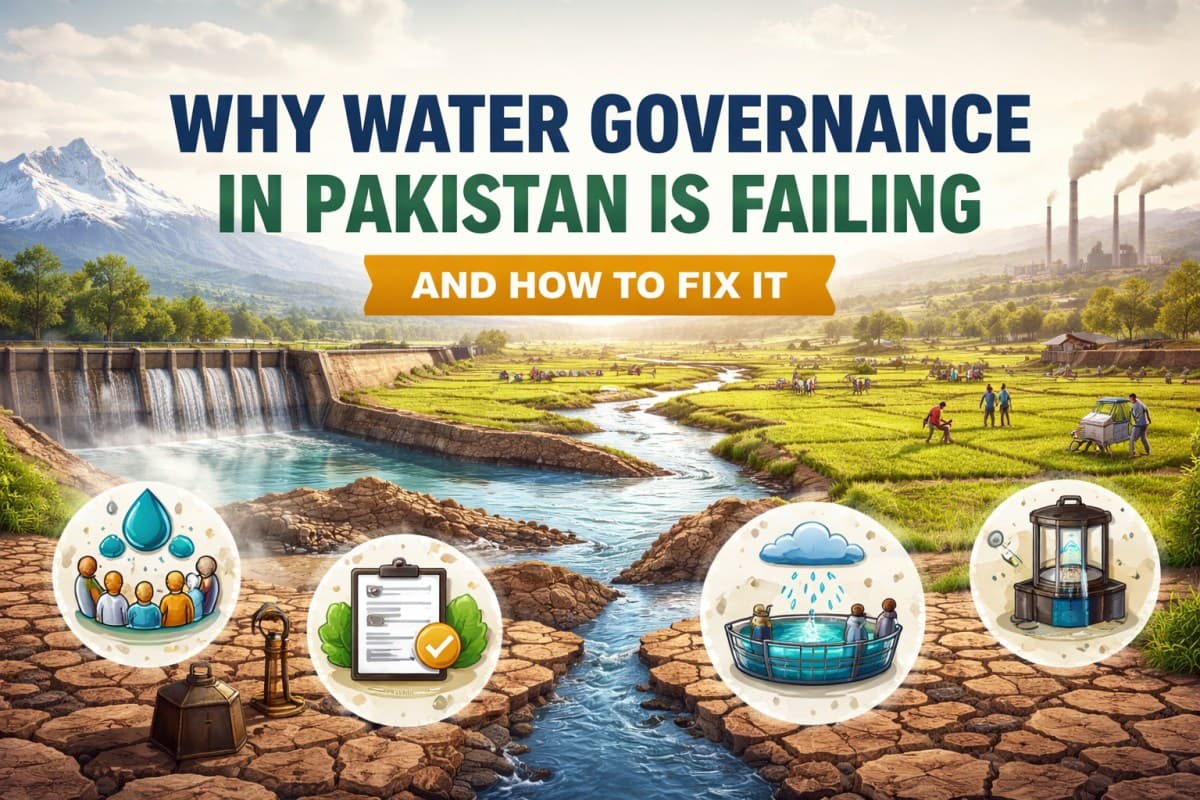
Why Water Governance in Pakistan Is Failing and How to Fix It
Explore why water governance in Pakistan is failing and discover practical solutions to improve water management, sustainability, and equitable distribution.

Introduction
Pakistan is an agricultural country. The agriculture sector consumes 90% of the available water (Hasan et.al). That’s why water is considered the backbone of Pakistan’s economy and agriculture. Pakistan receives 145 MAF average annual flows, in which glacier contribution is 40%, snow 22% and rainfall 27%. Out of 145 MAF, around 105 MAF is available at canal head withdrawal, whereas 10 MAF are system losses and 30 MAF directly goes to sea unutilized (Pakistan Engineering Congress, 2015). Surface supplies are insufficient to meet agricultural, domestic and industrial needs; the deficiencies are fulfilled by groundwater, which is also depleting at a very fast rate.
Despite having the vast Indus Basin irrigation system, Pakistan is rapidly approaching water scarcity due to governance failures, policy gaps, climate change, and inefficient management. This blog explores why water governance in Pakistan is failing and outlines practical solutions to fix it.
“Every drop wasted reflects a gap in governance, not just a loss of resource.”
Understanding Water Governance in Pakistan
Water governance means political, social and administrative processes to manage, allocate and protect water resources. It involves government institutions, policies, infrastructure, and stakeholder participation. Research shows that Pakistan is facing a serious water crisis. Water scarcity in Pakistan is driven not only by climate change but also by governance failures like fragmented institutional mandates, weak enforcement of regulation, outdated infrastructure, groundwater over-exploitation, etc. Without strong governance, water resources become vulnerable to overuse, pollution, and inequitable distribution.
The Water Crisis in Pakistan: Key Facts
Several alarming indicators highlight the urgency of reforming water governance in Pakistan:
- Per capita water availability has dropped from 5260 m3 in 1950 to less than 1000 m3 to date, approaching absolute water scarcity.
- Balochistan is already water scare because it has 250m3 per capita water availability.
- Indus basin aquifer is the 2nd most over stressed aquifer in world which meets around 50% water requirement of agriculture sector, 70% domestic and 100% industrial demand.
- Average annual abstraction of groundwater is more than 55 MAF which has crossed the safe yield limit.
- Many tubewells have gone out of production whereas production of many tubewells has reduced below 50%.
- Groundwater has become inaccessible in 15% and 20% of the irrigated area of Punjab and Baluchistan respectively
- Pakistan stores only 10% of available annual flows against the world average of 40% That’s why Pakistan has only 30 days storage as compare to India and America which have 130 days and 900 days storage respectively.
- Pakistan population has increased by 2.6 times during last 6 decades but storage capacity remained stagnant that is around 14 MAF including Terbela, Mangla and Chashma. Pakistan has not built any new storage since commissioning of Terbela.
- On an average, annually 30 MAF water goes to sea unutilized because of limited storage capacity. (Pakistan Engineering Congress, 2015)
Why Water Governance in Pakistan Is Failing
1. Climate Change
Pakistan is located in a heat surplus zone, which makes the country more vulnerable to climate change. Pakistan ranked among top 10 countries which are highly affected by prevailing challenge of climate crisis. During the last three decades, Pakistan has witnessed intense and frequent floods, long-duration droughts, heat waves, erratic rainfall patterns, glacial retreats, and Glacial Lake Outburst Flood (GLOF) phenomena. These climate crises make water availability highly unpredictable, which leads to poor planning and management of already fragile water resources. Without climate-adaptive policies, water governance in Pakistan will continue to struggle.
2. Fragmented Institutional Mandate
Roles and responsibilities of federal and provincial departments need to be clarified and well-coordinated. Overlapping institutional responsibilities often leads to confusion, policy gaps and ineffective implementation of regulations. Without a clear mandate, it becomes difficult to improve institutional performance. Ultimately, this lack of clarity weakens the accountability process and reduces the overall effectiveness of governance.
3. Lack of Reliable Database
Accurate, transparent and reliable data develop a strong data-driven decision support system which enables more effective planning and policy formulation. When decision-makers have access to accurate data, they can better understand water availability and demand, allowing them to frame sustainable solutions. On the other hand, poor data quality results in weak planning, inefficient management, and policies that fail to address real needs.
4. Over-Exploitation of Groundwater
The Indus Basin aquifer is the second most overstressed aquifer in the world, yet it remains a critical source of water for Pakistan’s economy and livelihoods. It contributes more than 50% to the agriculture sector, provides 70% of the domestic water supply and fully fulfils 100% of the water needs of industry (Hydroinsight.online). However, unregulated and uncontrolled abstraction of groundwater has put this precious resource under serious threat. Since the 1960s, Pakistan has mainly focused on the development of groundwater by installing tubewells and never paid attention to its monitoring, management and regulation.
As a result, depth to the water table has reached alarming levels in many parts of the country. If this trend continues without effective regulation, monitoring, and sustainable management practices, it could lead to severe water scarcity and long-term risks to agricultural productivity and economic stability. Weak monitoring and regulation illustrate the shortcomings of water governance in Pakistan in managing underground water resources.
5. Financial Constraint
Financial constraints have significantly contributed to the failure of effective water governance in Pakistan. Although feasibility studies of many projects, including dams, barrages and canals, have been conducted, they could not be completed due to lack of funds. Additionally, institutions responsible for water management often lack budgets to enforce regulation effectively.
This situation largely stems from the low priority given to water-related projects in national planning. Historically, the water sector has received limited attention from political leadership, which has further weakened governance and hindered the development of sustainable water management systems in the country.
6. Weak Enforcement of Regulation
In Pakistan, several water-related policies and laws exist, but their implementation remains a persistent challenge. The National Water Policy, introduced in 2018, addresses key issues regarding water resources development, management and protection and proposes solutions to these challenges. However, its implementation has remained limited, ultimately reducing its potential impact.
Similarly, the Water Apportionment Accord of 1991 needs to be reviewed under prevailing challenges of climate change and water scarcity. Rather than allocating a fixed share of water among provinces, allocation should be linked with efforts of water conservation, management and adoption of improved irrigation practices.
7. Outdated Infrastructure
Pakistan’s centuries old irrigation infrastructure comprises dams, barrages and canals which has received limited modernization and rehabilitation. These aging structures suffer from poor maintenance, sedimentation and structural deterioration. As a result, large amount of water loses in seepage. Moreover, this infrastructure could not efficiently distribute the due share of water among province.
Storage capacity of dams has reduced due to sedimentation, canals capacity has reduced due to siltation especially in the end reaches which ultimately led to running the canal at low capacity which badly affect the agriculture in the command, barrage capacity couldn’t counter the extreme floods as witnessed in 2010 & 2025 flood. Consequently, without substantial investment in upgrading and modernizing water infrastructure, efforts to improve water governance in Pakistan will remain significantly constrained.
8. Gender Mainstreaming and Inclusion
Women, small land holding farmers and marginalized community should be included in policy making because they represent more than 80% of the community and know ground realities and issues regarding water usage. Women, despite being primary users and managers of water at the household and community levels, are often excluded from decision-making processes related to water management and policy development. This exclusion leads to policies that are less responsive, less equitable, and less effective in addressing local water challenges.
Moreover, the absence of inclusive governance limits community ownership and reduces the overall effectiveness of water management initiatives. Therefore, without integrating gender perspectives and ensuring the participation of all stakeholders, water governance in Pakistan remains incomplete and less capable of achieving sustainable and equitable water management.
9. Bureaucratic hurdle
Bureaucratic hurdles are a major reason for the failure of water governance in Pakistan because they create delays, inefficiencies, and confusion in decision-making and implementation. Overlapping or unclear mandates among ministries and agencies create confusion about who is accountable for planning, monitoring, and enforcing water policies. This leads to gaps in implementation.
Moreover, Excessive bureaucracy can obscure responsibility. When a project fails or mismanagement occurs, it becomes difficult to pinpoint who is responsible, reducing institutional accountability.In short, bureaucracy slows down action, reduces efficiency, and prevents effective governance. Even with good policies, without streamlined administrative processes, water governance in Pakistan struggles to achieve results.
How to Fix Water Governance in Pakistan
Despite the challenges, several policy reforms and strategies can strengthen water governance in Pakistan.
1. Implement Integrated Water Resource Management (IWRM)
Traditional and fragmented sectoral approach to water resource management has led to poor services and unsustainable resource use. Integrated Water Resource Management (IWRM) replaces the fragmented sectoral management with coordinated management of water, land and related resources to maximize economic efficiency, social equity and ensuring the ecosystem sustainability. By aligning federal and provincial policies, Pakistan can ensure efficient water allocation and reduce institutional conflicts. This integrated approach is widely recommended by researchers as a framework to improve water governance in Pakistan.
2. Expand Water Storage and Infrastructure
As highlighted above, Pakistan has limited storage as compared to global standards. Pakistan needs an additional 40 MAF of storage by 2050 to meet the future needs of water. This is only possible by constructing new dams. Moreover, it needs to improve the existing irrigation infrastructure to wisely manage, allocate and protect the water. Strengthening infrastructure will play a crucial role in improving water governance by enhancing supply management across the country.
3. Improve Groundwater Monitoring and Regulation
Uncontrolled and unregulated abstraction of groundwater has put this precious resource under serious threat. To protect the Indus Basin Aquifer, regulatory frame work need to be developed on immediate basis. Possible measures include:
- Water Licensing: People or Industries may need permission before Installing a new tubewell or extract water.
- Metering and Water Pricing: Meter should be installed to measure the quantity of water being consumed. Moreover, per unit volume rate need to be specify and people or industry should be charged accordingly.
- Enforcement of Regulations: Fines or penalties need to be imposed on violators of the set rules and policies.
- Monitoring and Management: Data regarding depth to water table need to be monitor on regular basis to develop data-driven decision support system.
- Pollution Control Rules: Limits on dumping waste, chemicals, or sewage that can contaminate groundwater
4. Reform Water Laws and Regulatory Frameworks
Water policies and laws need to be reviewed and revised by considering the prevailing challenges of climate change, water scarcity and food insecurity. Key reform includes:
- Climate-resilient water policies
- Strong enforcement of regulation
- Groundwater regulation
- Water quality/pollution control laws
Legal reform can create accountability and strengthen water governance in Pakistan.
5. Increase Public Participation and Transparency
Women, small landholding farmers and marginalized groups should be given representation in policymaking. Community involvement can strengthen governance systems.
The policymaking process should include the following:
- Water user association
- Stakeholder participation
- Gender-inclusive water committees
Gender inclusion and stakeholder participation help in policy making based on real and grassroots-level challenges, such as ensuring that the needs of both men and women are addressed in water management strategies. This approach will help in significantly improving water governance in Pakistan.
6. Empowering Technocrats
Empowering technocrats in Pakistan’s water sector means giving technically trained professionals like engineers, water experts key roles in policy formulation, planning, and implementation. Empowering technocrats ensures that water governance in Pakistan is scientific, efficient, transparent, and forward-looking, rather than reactive, fragmented, or politically driven. By combining political oversight with technical expertise, Pakistan can make meaningful progress toward sustainable water management.
Conclusion
Pakistan’s water crisis has raised questions on water governance. Despite having one of the largest irrigation systems in the world, weak institutional coordination, outdated infrastructure, weak enforcement of regulation, and limited stakeholder inclusion have pushed the country toward water scarcity. Climate change has further intensified these challenges, making water availability highly unpredictable.
However, the situation is not irreversible. With the adoption of integrated water resource management, expansion of storage capacity, effective groundwater regulation, legal reforms, and inclusive policymaking, Pakistan can move toward a more secure and sustainable water future. Strengthening governance is the key to ensuring that water resources are managed efficiently, protected responsibly, and distributed fairly. If timely and coordinated actions are taken, Pakistan can not only address its current water challenges but also secure its agricultural productivity, economic stability, and environmental sustainability for future generations.
“When governance fails, even the mightiest rivers cannot sustain a nation.”
References
https://thediplomat.com/2024/03/the-role-of-water-governance-in-pakistans-water-crisis/
FAQs
What is the governance of the water?
Water governance involves the political, social, economic, and administrative systems that determine how water resources are developed, managed, and allocated. Effective water governance ensures equitable distribution, better management and sustainable use of water through policies, institutions, and stakeholder participation, crucial for addressing water scarcity and climate change.
What are the seven principles of water governance?
The principles presented here include the human right to water, ecosystem centrality, the principles of shared integration, precautionary, responsibility, and subsidiarity, along with the concept of the common good.